


Youth Baseball Glove Sizing by Position: A Parent's Guide
Last Updated: October 29, 2026
Quick Summary
Youth baseball glove sizing by position means matching glove length to the spot a player covers, then confirming the fit on their hand. Infielders typically fit 10.5" to 11.5" gloves, outfielders 11.5" to 12.5", youth catcher's mitts run 30" to 32" in circumference, and first-base mitts 12" to 13".
- Measure the glove from the top of the index finger to the heel of the palm.
- In the fit test, the index finger should reach within about a half-inch of the top of the finger slot.
- An I-web or V-web with medium pocket depth encourages a quick release for infielders.
- A 12" Wilson A500 with a Dual Post Web suits players ages 6 and older moving between positions.
- Buy soft, game-ready leather in the size that fits now, since it will not shrink to the hand.
Table of Contents
- Youth Baseball Glove Size Chart by Age
- How to Measure a Baseball Glove and a Young Player's Hand
- Youth Infield Glove Size: Shortstop, Second Base and Third Base
- Youth Outfield Glove Size and the Extra Reach It Buys
- Catcher's Mitt and First-Base Mitt Sizing for Young Players
- How to Test Fit on a Young Player's Hand
- Fit Now or Room to Grow: What Break-In and Materials Tell You
- Get Your Player Fitted at Prime Sports
- Frequently Asked Questions
Youth Baseball Glove Size Chart by Age
Youth baseball glove sizing starts with age, but it ends with the player's hand. A glove that matches a birthday but swallows a small palm costs a young infielder control on every ground ball.
Here is a baseline chart for fitting young players:
| Age Range | Common Positions |
|---|---|
| 5-7 | All-purpose, tee ball |
| 8-10 | Infield, pitcher, outfield |
| 11-12 | Infield, outfield, first base |
| 13-14 | Position-specific |
| High school | Position-specific |
Treat the chart as a starting point, not a rule.
For a deeper age-by-age walkthrough that confirms these numbers, see our guide on how to choose baseball glove size for youth.
How to Measure a Baseball Glove and a Young Player's Hand
Measuring takes two minutes and prevents a season of frustration. Measure the glove from the top of the index finger to the heel of the palm, then measure the player's hand from the base of the palm to the tip of the index finger.
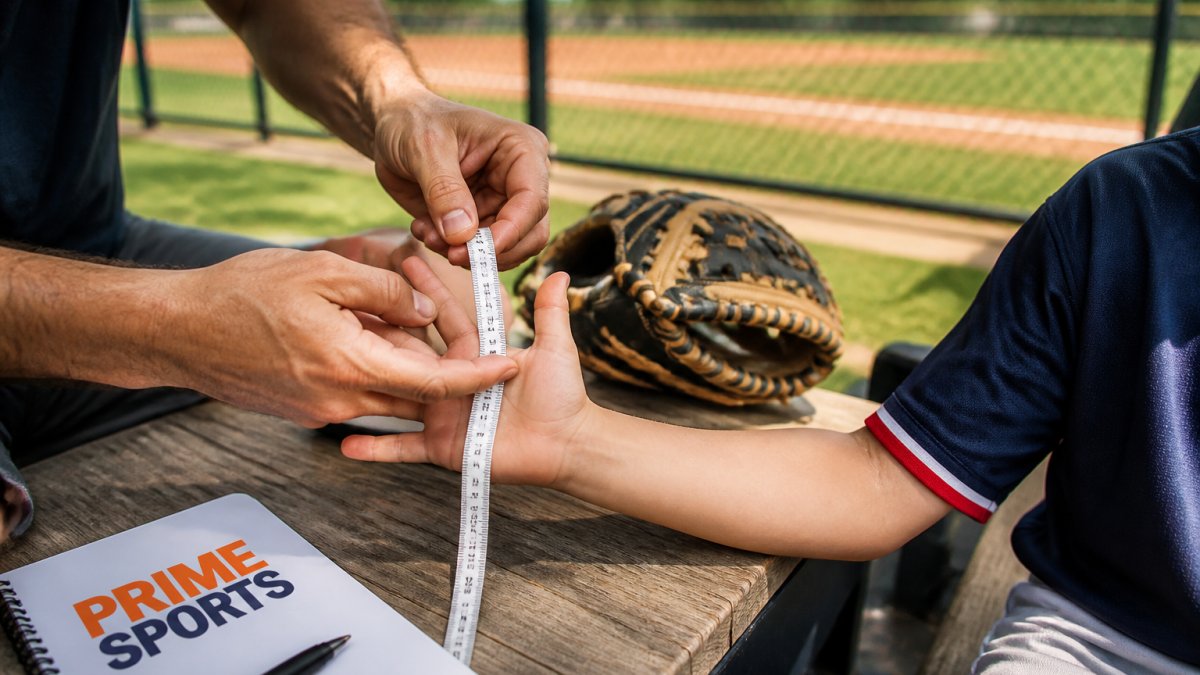
Follow these steps:
- Lay the glove flat and run a soft tape from the top of the index finger to the bottom edge of the palm.
- Record that number in inches, the glove length printed on the model.
- Have the player hold their throwing hand flat, fingers together.
- Measure from the crease at the wrist to the tip of the middle finger.
- Compare the two. A young player should be able to squeeze the glove closed with light effort.
Palm width matters too. Look for an adjustable wrist strap so the glove hugs the back of the hand.
The Four-Point Fit Test Every Parent Should Run
A tape measure gets you into the right size range, but it cannot confirm the glove works on that player's hand. Before you peel off the tags, run this four-point check with the glove on and the wrist strap fastened:
- Finger reach: The player's index finger should reach within about a half-inch of the top of the finger slot. If it stops well short, the glove is too long and the player will lose feel for the ball.
- Wrist closure: The strap should hold the glove snug against the back of the hand without pinching. If you can slide two fingers under a fastened strap, the glove will rotate on contact; red marks mean it is too tight.
- Closure effort: The player should close the glove thumb to pinky (outfield pattern) or thumb to middle finger (infield pattern) with one hand and light effort. A two-handed squeeze or a grimace means it is too stiff or too large.
Why Listed Length and Usable Pocket Are Not the Same Thing
Two gloves stamped 11.5" can feel completely different on the same hand. Listed length measures the shell from fingertip to heel, but the usable pocket depends on the web type, the padding, and how the glove is designed to close.
- Web type: An I-web or V-web creates a shallow, fast-release pocket for infielders. A basket web or dual post web creates a deeper, more forgiving pocket for outfielders and younger players still learning to catch.
- Padding: Catcher's and first-base mitts carry extra palm and edge padding that eats into usable pocket depth, which is why a 12" first-base mitt feels smaller inside than a 12" fielding glove.
- Closure pattern: A glove designed to close thumb to middle finger has a narrower, more controlled pocket than one designed to close thumb to pinky.
When you compare two gloves on the rack, put a ball in each pocket and squeeze. The one that wraps the ball more securely for that player's hand is the better fit, even if the other one is a quarter-inch longer on the label.
Youth Infield Glove Size: Shortstop, Second Base and Third Base
Infield play rewards quick transfers and control, so youth infield glove size runs smaller than outfield sizing.
The web matters as much as the length: an I-web or V-web with medium pocket depth encourages a quick release.
If you are ready to buy an infield-sized youth glove, the Marucci Krewe 11.50" Youth Baseball Glove is an 11.5" option built to fit pre-teen ballplayers.

Youth Outfield Glove Size and the Extra Reach It Buys
Outfielders need reach, so youth outfield glove size runs larger than infield sizing. A young outfielder typically fits a glove from 11.5" to 12.5", with the bigger end suited to players who can handle the weight.
A 12" model like the Wilson 2025 A500 Navy/Blue/Red 12.00" Baseball Glove suits players ages 6 and older moving between positions, with a Dual Post Web that holds its shape while reaching for the ball. Its full leather construction is soft and ready to play after a quick break-in.
Watch out: a small outfielder can lose control with a glove that is too long. Length adds reach but slows the transfer, so a young center fielder who also plays infield may be better served by a mid-size glove.
Catcher's Mitt and First-Base Mitt Sizing for Young Players
Catcher's mitts and first-base mitts follow different sizing rules than fielding gloves.
Young catchers should prioritize a mitt they can close with one hand. Stiff padding protects the hand, but a mitt a young player cannot squeeze will drop pitches.
Wilson 2025 A500 Red/Blue/White 11.50" Baseball Glove WBW102540115 →
Once the catcher's mitt is sized, parents often want the rest of the position gear. Our guide to the best protective gear for youth catchers covers what goes with the spot.
How to Test Fit on a Young Player's Hand
A glove passes the fit test when the player can close it with light effort and the heel sits at the base of the palm. Put the glove on, fasten the wrist strap, and check three things:
- Wrist: the strap should hold the glove snug without pinching.
- Fingers: the index finger should reach near the top of the finger slot, not stop well short.
- Closure: the player should close the glove thumb to pinky or thumb to middle finger with one hand.
If the glove flops open on its own or the hand slides inside, it is too big. If the player cannot close it, it is too stiff or too large. Have the player catch a few soft tosses to confirm control before you commit.
Fit Now or Room to Grow: What Break-In and Materials Tell You
The right call between a snug fit now and room to grow depends on the leather and the break-in.
Full-grain cowhide, like the shell on the Marucci Krewe line, holds its shape and breaks in to the player's hand over time. For detail on which leather types suit a growing player, read our guide to choosing the right baseball glove leather type.
If you are weighing a slightly larger, stiffer glove, our baseball glove break-in tips walk through the steps to soften it to the hand.
The Oversizing Trade-Off Nobody Charts
Sizing charts leave out the most important decision a parent makes: whether to buy the glove that fits today or the one the player will grow into by midseason.
A glove that is one size too large for a young player creates three problems that show up on the field:
- Slower transfers: An infielder with a loose glove has to re-grip the ball after every catch, the difference between turning a double play and eating the throw.
- Weaker closure: A player who cannot close the glove with one hand learns to catch two-handed or trap the ball against the body, habits that are hard to unlearn at the next level.
- Lost feel: A glove that swallows the hand deadens feedback through the palm, so young players get less information about where the ball hit the pocket.
A common pattern among youth coaches is that a player who is over-gloved for a season develops slower than a peer in a correctly sized glove, because every rep reinforces a workaround instead of a clean catch-and-transfer.
A Simple Decision Rule
Use the leather type and the player's hand strength to decide:
- Soft, game-ready leather (top-grain, pre-oiled): Buy the size that fits now. These gloves will not shrink to the hand, and a loose game-ready glove stays loose.
- Stiff, full-grain leather: You can buy at the top of the recommended range, not above it, if the player has the hand strength to close it after a proper break-in. Reserve this for players age 11 and up who are playing a full season at one position.
- Growing player switching positions: Buy for the primary position at a fit that works today. A glove sized for a position the player might play next year will be wrong for the position they play this year.
How Break-In Changes the Fit Over Time
Break-in does not just soften a glove, it reshapes the pocket to the player's hand.
Get Your Player Fitted at Prime Sports
Sizing a youth glove by position comes down to matching length to the spot, then confirming the fit on the player's hand.
At Prime Sports, we help families and coaches choose gloves for their players.
Frequently Asked Questions
What size baseball glove does a youth player need?
Most youth players ages 6 to 8 fit an 11-inch to 11.5-inch glove, ages 9 to 12 typically use 11.25 to 12 inches, and teens move into 11.5 to 12.75 inches depending on position. The right youth baseball glove sizing also depends on hand size and where the player lines up. A young shortstop needs a shorter glove for quick transfers, while an outfielder benefits from extra length. Always check the size chart by age, then confirm the fit on the hand before buying.
Do youth baseball glove sizes depend on position?
Yes. Position changes the ideal length and pocket depth. Infield gloves run about 11 to 11.75 inches with a shallower pocket for fast transfers. Outfield gloves run about 12 to 12.75 inches with a deeper pocket for tracking fly balls. Catcher's mitts are measured by circumference, usually 31 to 33 inches for youth, and first-base mitts run 12 to 13 inches. Matching glove size to position helps a young player field cleaner and throw quicker.
How do you measure a child for a baseball glove?
Measure from the base of the palm to the tip of the index finger, then compare that hand length to a youth baseball glove size chart by age. You can also measure the glove itself from the heel to the top of the web to confirm its listed length. A good fit leaves about a half inch of room at the end of the fingers and lets the player close the glove with moderate effort. Bring the player to try gloves on when possible.
What size glove should a youth catcher use?
Youth catcher's mitts are sized by circumference rather than finger length. Most young catchers fit a 31-inch to 32-inch mitt, and older or larger players move to 32.5 or 33 inches. The mitt should close around the ball without the player squeezing hard, and the wrist strap should sit snug so the mitt does not twist on impact. Catchers also need extra padding, so check that the palm feels protected when catching hard throws.
Can a youth player use an adult baseball glove?
An adult glove is usually too long and too stiff for a young player to control. Oversized gloves make it harder to close the glove, find the ball, and transfer it quickly, which slows development. A better path is a youth model sized to the player's hand and position. As the player grows into the teen years and hand size increases, stepping up to a larger youth or adult glove makes sense once the current glove feels tight or hard to close.
How should a youth baseball glove fit?
A well-fitted glove sits snug at the wrist, lets the fingers reach near the end of the stalls without pinching, and closes with moderate hand pressure. The player should be able to catch and transfer a ball without the glove sliding or twisting. Check that the web and pocket hold the ball securely and that the heel does not gap open. If the glove is loose or floppy, size down or tighten the wrist strap before the season starts.
