


Choosing the Right Baseball Glove Leather Type
Last Updated: October 23, 2026
Quick Summary
The baseball glove leather type you choose determines how your glove feels, how long it lasts, and how fast it breaks in. Steerhide offers durability and shape retention over 4-8 weeks, kip leather softens faster in 1-3 weeks but loses pocket definition, and Japanese kip balances both in 2-4 weeks.
- Steerhide gloves take 4-8 weeks to break in but maintain pocket shape through multiple seasons of heavy use.
- Kip leather softens within 1-3 weeks but can lose pocket definition and original shape during break-in.
- Japanese kip leather, sourced from the top 1% of hides, softens in 2-4 weeks while maintaining better structural integrity than standard kip.
- Youth players under 12 benefit most from kip or Japanese kip leather due to faster break-in and lower hand strength requirements.
- Steerhide requires moderate conditioning every 2-3 months, while kip leather needs lighter conditioning every 3-4 months to avoid over-oiling.
Table of Contents
- Why Leather Type Matters When Choosing a Baseball Glove
- Steerhide vs. Kip Leather: The Core Difference
- Other Leather Options: Cowhide, Japanese Kip, and Full-Grain
- Best Baseball Glove Leather for Youth Players
- How to Break In a Baseball Glove by Leather Type
- Baseball Glove Leather Care and Conditioning
- Decision Matrix: Matching Leather Type to Your Needs
- Frequently Asked Questions
Why Leather Type Matters When Choosing a Baseball Glove
The baseball glove leather type you choose determines how your glove feels, how long it lasts, how fast it breaks in, and whether you'll still trust it in the bottom of the ninth. Most players focus on size and price first.

A steerhide glove plays completely differently than a kip leather glove from day one. One softens gradually over weeks. The other demands patience for months. One holds its shape through a full season.
Match the leather type to your timeline, position, budget, and willingness to break in a glove. Get it right and you'll have a reliable tool for years; get it wrong and you're fighting the glove instead of using it.
Steerhide vs. Kip Leather: The Core Difference
The fundamental split in baseball glove leather comes down to steerhide and kip leather. These two materials behave so differently that understanding the core difference saves you from buying the wrong glove.
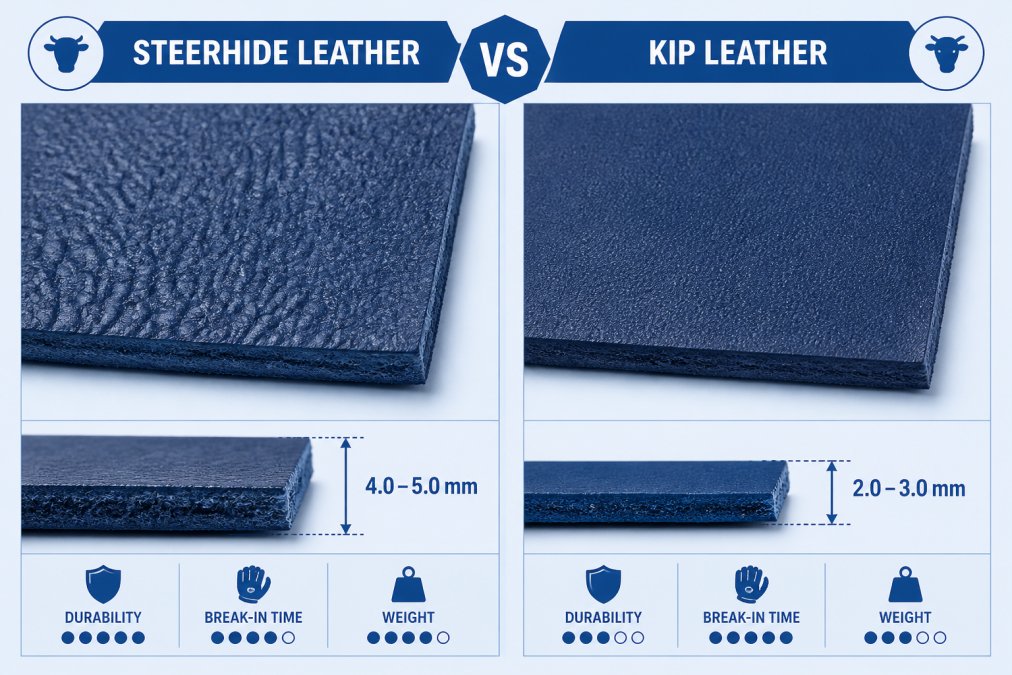
Steerhide is leather from the hide of a steer (a castrated bull).
Kip leather comes from younger cattle, producing a thinner, more pliable hide that softens faster and molds to your hand more readily.
Steerhide: Durability and Structure
Steerhide gloves suit players who want a glove that lasts multiple seasons and maintains its pocket shape through heavy use. The leather arrives stiff, and breaking it in requires patience, but that same stiffness is what keeps your pocket from collapsing after 200 ground balls.
Rawlings Heart of the Hide gloves, like the Rawlings Heart of the Hide 12" Baseball Glove PROR206-30GB ($329.99), exemplify what steerhide offers: premium steerhide that resists compression and maintains pocket integrity, feeling stiff out of the box but developing a smooth, broken-in feel after 4-8 weeks of regular play.
Kip Leather: Softness and Faster Break-In
Kip leather gloves prioritize early comfort and faster game-readiness, softening within 1-3 weeks of regular play. Players who want a glove that feels broken in quickly, without extensive conditioning work, gravitate toward kip leather.
The Rawlings Pro Preferred 11.50" Baseball Glove PROS934-2BRC ($419.99) uses premium kip leather and represents the high end of the kip leather market. It softens predictably, forming a pocket that molds to your hand, and reaches game-ready status faster than steerhide.

Kip leather does soften significantly, so the glove's original pocket shape can shift. Some players view this as the glove adapting to their hand, others as pocket definition being lost.
Other Leather Options: Cowhide, Japanese Kip, and Full-Grain
Beyond steerhide and standard kip leather, several other baseball glove leather type options appear in baseball gloves.
Cowhide is the broadest label: leather from cattle, which includes steerhide and leather from female cattle. It's generally less expensive than steerhide but also less consistent in quality and durability.
Full-grain leather describes processing, not animal source.
Top-grain and corrected-grain are the other side of that coin. Top-grain has the outermost layer sanded away to remove imperfections, which makes it smoother and more uniform but less durable than full-grain.
Japanese kip leather is a premium tier within kip leather, known for fine texture, consistent quality, and exceptional softness without sacrificing durability. The Warstic IK3 Series Japanese Kip 12.75" Baseball Glove (Bison) ($369.00) uses top-tier Japanese kip leather sourced from the top 1% of hides.

"Pro-grade" and similar labels are the least standardized terms on a glove. They are not a leather grade in the technical sense; they are manufacturer positioning.
Best Baseball Glove Leather for Youth Players
Youth players face a specific challenge: they're still growing, their hand strength is developing, and they may lack the patience for a glove that takes months to break in. The best baseball glove leather for youth depends on age and experience level.
For players under 12, kip leather or Japanese kip offers the fastest path to a usable glove. Youth players benefit from gloves that feel comfortable early because they're still building hand strength and confidence.
For players 13 and older with some experience, steerhide becomes viable. Older youth players understand the break-in process and have the hand strength to condition a stiffer glove.
Japanese kip leather bridges both groups. It softens faster than steerhide but maintains better shape than standard kip leather. For youth players who want reliability without extensive break-in, Japanese kip is the practical choice.
Warstic IK3 Series Japanese Kip 12.75" Baseball Glove - Bison →
How to Break In a Baseball Glove by Leather Type
Break-in strategy depends entirely on your leather type. The wrong approach wastes time and can damage the glove.
Steerhide break-in requires consistent, patient conditioning.
Kip leather break-in is faster but still requires intentional work. Use a lighter hand with conditioner since kip absorbs oils more readily than steerhide, and play catch to shape the pocket.
Japanese kip leather break-in follows a middle path. The leather softens faster than steerhide but maintains structure better than standard kip. Use moderate conditioning and regular play. Most Japanese kip gloves are game-ready within 2-4 weeks.
The common mistake is over-conditioning any leather type. Excess oil weakens the fibers and accelerates wear. Condition lightly, then let play do the work.
Baseball Glove Leather Care and Conditioning
Leather maintenance determines how long your glove lasts and how well it performs. Different leather types require slightly different care approaches.
Steerhide gloves benefit from regular conditioning because the leather naturally resists moisture and softening. Condition every 2-3 months during the season, or every 4-6 months during off-season.
Kip leather gloves need lighter conditioning. The leather absorbs oils more readily, so condition less frequently, every 3-4 months during the season, and only when needed.
Japanese kip leather sits between the two. Condition every 2-3 months with a light hand.
Store all gloves in a cool, dry place. Avoid direct sunlight, which can fade and weaken leather. Never store a wet glove.
Decision Matrix: Matching Leather Type to Your Needs
Most guides stop at describing leather categories.
| Factor | Steerhide | Kip Leather | Japanese Kip |
|---|---|---|---|
| Break-in Time | 4-8 weeks | 1-3 weeks | 2-4 weeks |
| Durability | Excellent | Good | Excellent |
| Pocket Retention | Maintains shape | Softens, loses definition | Maintains shape |
| Best For | Competitive players, multiple seasons | Fast game-readiness, budget-conscious | Balance of break-in speed and durability |
| Youth Players | 13+, experienced | Under 12, beginner | All ages |
| Price Range | $300-$420+ | $250-$350 | $350-$400+ |
| Conditioning Needs | Moderate | Light | Moderate |
Step 1: Set your break-in budget. Decide how many weeks you can realistically spend working the glove before it needs to be game-ready.
Step 3: Weight position demands. Infielders who need a quick, shallow pocket and fast hand transfers tend to prefer kip or Japanese kip because the glove feels broken in sooner.
Step 4: Check the budget against lifespan. A $250-$350 kip glove that softens out of shape in one season can cost more per year than a $300-$420 steerhide glove that holds structure for three.
Step 5: Confirm the conditioning commitment. Steerhide and Japanese kip reward regular conditioning; kip needs a lighter hand.
If you need a glove game-ready in two weeks, steerhide isn't your answer. If you want a glove that lasts three seasons without losing pocket shape, kip leather isn't the choice. If you want both speed and durability, Japanese kip is worth the investment.
Frequently Asked Questions
What is the best leather for a baseball glove?
The best baseball glove leather depends on your position, budget, and break-in preference. Steerhide offers superior durability and structure, making it ideal for infielders and experienced players willing to invest time in break-in. Kip leather provides a softer feel and faster game-ready timeline, suiting outfielders and players seeking immediate comfort. Japanese kip combines the best of both: premium softness with solid durability. For competitive play, premium steerhide or kip leather outperforms synthetic options in feel, pocket development, and longevity.
What is the difference between kip leather and steerhide for a baseball glove?
Kip leather comes from younger cattle and has a finer grain, making it softer and more flexible right out of the box. Steerhide comes from mature cattle and is thicker, stiffer, and more durable, but requires longer break-in. Kip leather typically breaks in faster than steerhide. Steerhide gloves are generally more durable than kip leather gloves. Kip leather is lighter, making it popular with outfielders; steerhide's structure appeals to infielders who need consistent pocket shape and control.
How long does it take to break in a leather baseball glove?
Break-in time varies by leather type. Kip leather gloves typically reach game-ready condition faster than steerhide gloves. Steerhide gloves usually require more hours of use to fully form to your hand. Accelerate break-in by playing catch, using a glove mallet, applying conditioner, and storing the glove with a ball in the pocket overnight. Avoid over-conditioning, which can soften the structure and reduce durability. Patience during break-in preserves the glove's shape and extends its lifespan.
How should I care for and condition a leather baseball glove?
Clean your glove after each use with a dry cloth to remove dirt and moisture. Condition every 3-6 months or when the leather feels dry using a leather conditioner designed for baseball gloves. Apply conditioner sparingly to avoid over-softening the structure. Store your glove in a cool, dry place with a ball in the pocket to maintain shape. Avoid extreme heat, direct sunlight, and excessive moisture. For steerhide, use heavier conditioning; kip leather needs lighter, less frequent conditioning. Proper care prevents cracking, maintains pocket integrity, and can extend your glove's lifespan.
Is synthetic leather better than real leather for a baseball glove?
Real leather outperforms synthetic for serious players. Genuine leather develops a custom pocket that conforms to your hand over time, improving feel and control. Steerhide and kip leather also offer superior durability and weather resistance. Synthetic gloves may be cheaper and require less break-in, but they don't develop the same pocket shape, feel, or longevity. Synthetic materials can feel stiff and don't provide the same feedback when fielding. For competitive play at any level, premium real leather is the standard choice among coaches and experienced players.
Which leather is easiest to break in for a baseball glove?
Japanese kip leather breaks in fastest, while standard kip leather also offers a quicker break-in. Both are softer and more pliable than steerhide from day one. If you need a game-ready glove quickly, kip leather is your best option. Steerhide, though it requires more break-in time depending on grade, ultimately becomes more game-ready due to its structural consistency. For youth players or those with limited practice time before competition, kip leather's faster break-in makes it the practical choice.
What leather should a youth baseball player choose?
Youth players benefit most from kip leather gloves because they break in quickly, feel comfortable, and remain affordable compared to premium steerhide. Japanese kip is an excellent upgrade if budget allows, offering premium softness without the lengthy steerhide break-in. Full-grain cowhide is a budget-friendly entry point for beginners, though it won't match the performance of kip or steerhide. Consider the player's position: outfielders prefer lighter kip leather, while infielders may benefit from steerhide's structure as they advance. Start with appropriately sized kip leather, and upgrade to steerhide as the player matures and gains experience.
