


How to Choose Baseball Glove Size for Youth: 2026 Guide
Table of Contents
- Why the Right Youth Baseball Glove Size Matters
- Youth Baseball Glove Size Chart by Age
- How to Measure Your Child's Hand for a Glove
- The Difference Between Infield and Outfield Gloves
- Youth vs. Adult Gloves: Key Differences
- Signs Your Child's Glove Is Too Big or Too Small
- How to Break In a Baseball Glove
- Choosing the Right Glove at Prime Sports
- Frequently Asked Questions
Last Updated: October 4, 2026
Why the Right Youth Baseball Glove Size Matters
Knowing how to choose baseball glove size for youth is the difference between a young player catching the ball cleanly and fighting the leather every time a grounder comes their way. At Prime Sports, we see it every season.
Here's the problem with guessing. An oversized glove feels heavy, slides around on the hand, and makes it harder to squeeze the pocket shut. A glove that's too small leaves too little room to catch the ball at all.
This guide walks through age-based sizing, hand measurement, position differences, and break-in. We also cover the signs that a glove no longer fits. That way you buy once and buy right.
Youth Baseball Glove Size Chart by Age
Age gives you a starting point, not a final answer. Use the chart below to find a range, then confirm the fit with a hand measurement.
| Age | Glove Size | Typical Position |
|---|---|---|
| 4-6 | 9" to 9.5" | Any (tee ball) |
| 7-8 | 9.5" to 10.5" | Infield, outfield |
| 9-10 | 10.5" to 11" | Infield, outfield |
| 11-12 | 11" to 11.5" | Infield, outfield |
| 13-14 | 11.5" to 12" | Infield, outfield, pitcher |
How to Use the Chart
Start with the age row, then adjust. A small-framed 11-year-old may fit an 11" glove better than an 11.5". A big 10-year-old may be ready for 11.25".
Measure the hand before you buy. The chart narrows the field. The measurement picks the winner.
How to Measure Your Child's Hand for a Glove
Hand measurement is the step most families skip, and it's the one that matters most. You need a flexible tape measure and about two minutes.
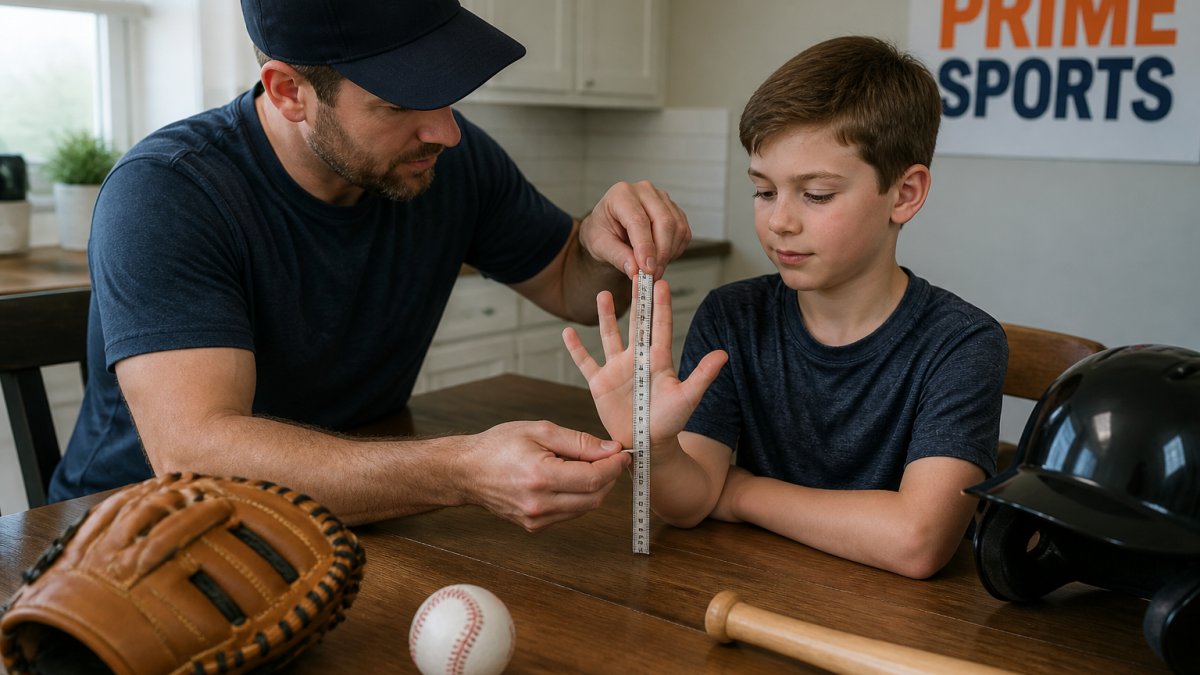
Palm-to-Finger Measurement
- Have your child hold their glove hand flat, fingers together.
- Place the tape at the base of the palm, right at the wrist crease.
- Run the tape to the tip of the middle finger.
- Write down the number in inches.
- Repeat on the other hand to check consistency.
A palm-to-finger measurement under 6 inches points to a youth glove. Over 7 inches often means an adult or intermediate model fits better. For a deeper look at how glove sizing works across the sport, USA Baseball's youth player resources offers guidance on age-appropriate equipment.

Testing Fit with the Pinky Rule
The pinky rule is a quick fit check. Have your child put the glove on and hold their hand up.
- The pinky finger should sit in the glove's pinky stall, not the ring finger stall.
- The index finger can sit in the index stall or point out for more control.
- The wrist strap should close snug without pinching.
If the hand swims inside the glove, size down. If the fingers push against the tips, size up.
The Difference Between Infield and Outfield Gloves
Position changes the ideal glove size, and it changes the pocket geometry too. An infielder needs a shorter glove with a shallow pocket for quick transfers.
- Infield glove: 11" to 11.5", shallow pocket, open web
- Outfield glove: 12" to 12.75", deep pocket, closed or H-web
- Pitcher's glove: 11.5" to 12", closed web to hide the grip
- Catcher's mitt: measured differently, with extra padding and a closed, heavily padded pocket
- First base mitt: 12" to 12.5", long and scooped, with a shallow web
For young players still learning every position, a mid-size glove around 11" to 11.5" works everywhere. A modified T-web with medium pocket depth handles infield and outfield duty without forcing a second glove purchase mid-season.
Web pattern matters too. An open web lets infielders see through the glove to the ball on grounders and gives them a lighter, more flexible frame.
Softball vs. Baseball: Why the Pocket Differs
This is the mix-up that costs families the most money. A softball is larger and softer than a baseball, so a softball glove is built with a deeper, wider pocket and a heavier, more padded frame to absorb the extra mass. A baseball glove has a shallower, narrower pocket tuned to the smaller, harder ball. If you hand a young softball player a baseball glove, the ball rattles around and pops out. If you hand a baseball player a softball glove, the ball buries in the pocket and the player can't find it for a quick throw.
Weight: The Factor Nobody Talks About
A glove that is one inch larger can weigh noticeably more, and for a 7- or 8-year-old that extra weight shows up as a glove that droops at the wrist and a player who catches with two hands. Most youth gloves in the 9" to 11" range fall in the 11 to 16 ounce range depending on leather type and padding. When you move a young player up a size, check whether the model is built on a lighter frame.

USA Baseball's youth player resources offers guidance on age-appropriate equipment for players still settling into a position.
Youth vs. Adult Gloves: Key Differences
Youth gloves are built smaller, lighter, and with softer leather. Adult gloves use stiffer leather and larger patterns. That's the short version. Here's what actually changes between the two, and why it matters when you're standing in a store with a growing kid.
- Frame and weight. A youth glove in the 10" to 11" range typically weighs 11 to 16 ounces. An adult infield glove of similar listed size often runs 18 to 24 ounces because of thicker leather and more padding. That weight difference is the single biggest reason young players can't close an adult glove.
- Wrist opening. Youth gloves use a tapered wrist opening and a shorter wrist strap so a smaller hand can actually tighten the glove. An adult wrist opening will not cinch down far enough on most players under 12.
- Finger stalls. Youth gloves have shorter, narrower finger stalls. If a child's fingers don't reach the end of the stall, they can't leverage the glove closed, no matter how hard they squeeze.
- Leather stiffness. Adult gloves are built from stiffer steerhide or full-grain leather that holds its shape for years but takes weeks or months to break in. Youth gloves use softer full-grain or synthetic leather that is game-ready almost immediately.
- Pocket depth. Youth patterns use shallower pockets matched to smaller hands and slower reaction times. Adult pockets are deeper and reward a player who can already read the ball off the bat.
A common mistake is buying an adult glove for a young player because "they'll grow into it." They won't, at least not before the glove has taught them bad habits.

If your child is between sizes, buy the smaller one. A snug fit beats a roomy one every time.
Marucci Krewe 11.00" Youth Baseball Glove: MFG3KR41A7-BK/NG →
How Long Will It Last? The Budget-to-Performance Question
Parents ask this more than any other question, and most sizing guides skip it. The honest answer is that a youth glove's useful life is usually limited by hand growth, not by wear. A well-cared-for youth glove in the 9" to 11" range often serves a player for one to two seasons before the hand outgrows it.
That math changes how you should spend. If your player is 6 or 7 and still growing fast, a mid-range youth glove that fits well now is usually the smarter buy than a premium glove they'll outgrow in 18 months.
Little League's official equipment guidance notes that properly fitted gear helps young players stay safe and build skills across multiple seasons.
Signs Your Child's Glove Is Too Big or Too Small
Watch how the glove behaves during catch. The glove tells you when it doesn't fit.
Signs the glove is too big:
- The ball pops out on routine catches
- The glove slides around when your child squeezes
- The wrist strap won't tighten enough
- Your child uses two hands to close the glove
Signs the glove is too small:
- Fingers press hard against the tips
- The ball hits the heel instead of the pocket
- Your child can't close the glove around the ball
- Red marks or sore spots on the hand after practice
Either problem hurts development. Fix the fit before the season starts.
Little League's official equipment guidance notes that properly fitted gear helps young players stay safe and build skills. A glove that fits is part of that.
How to Break In a Baseball Glove
A new glove needs break-in before game use. The goal is a glove that closes around the ball and holds its shape.
- Play catch often. Nothing breaks in a glove faster than repeated catches.
- Shape the pocket by hand. Bend the glove at the hinge point, not the middle.
- Store a ball in the pocket. Wrap the glove with a strap overnight.
- Use a small amount of glove oil or conditioner sparingly. Too much softens the leather.
- Keep the glove out of heat. A hot car dries out leather and cracks it.
Youth gloves built from softer leather, like the Marucci Krewe line, need little to no break-in. That means more practice time and less waiting.
Choosing the Right Glove at Prime Sports
The right glove comes down to three checks: age range, hand measurement, and position. Get those right and the glove will serve your player for seasons.
At Prime Sports, we help families across the St. Louis area and nationwide find gloves that fit. Our team carries youth models from Marucci, Rawlings, Wilson, and more. We match the glove to the player's age, position, and budget. Stop by our Fenton or Chesterfield store, or shop online at PrimeSportsMW.com.
For more on youth gear, the CDC's youth sports safety guidance covers injury prevention basics every parent should know.
Frequently Asked Questions
What size baseball glove does a 7-year-old need?
Most 7-year-olds fit an 11-inch to 11.25-inch glove. At this age, players are still developing hand strength and dexterity, so a lighter glove with a medium pocket depth works best. The Marucci Krewe 11" Youth Baseball Glove is a strong option for younger players because it requires little to no break-in and offers a fast-closing pocket for quick transfers.
How do I measure my child's hand for a baseball glove?
Use a flexible tape measure from the base of the palm to the tip of the middle finger. This palm-to-finger measurement determines the glove length. A measurement of 6 to 6.5 inches typically fits an 11-inch glove, while 6.5 to 7 inches fits an 11.5-inch glove. Always have your child try the glove on and close it to confirm a snug fit.
Should a youth baseball glove be stiff or soft?
Youth gloves should be softer and more flexible than adult gloves. Young players need to close the glove easily to catch the ball and make quick transfers. A glove that is too stiff can frustrate a child and slow their development. Look for gloves with minimal break-in time, like the Marucci Krewe series, which offers a game-ready feel right out of the box.
Does the position played affect youth baseball glove size?
Yes. Infielders typically use smaller gloves (11 to 11.5 inches) for quicker transfers and better control. Outfielders need larger gloves (12 to 12.75 inches) for extra reach and a deeper pocket to track fly balls. Pitchers often use 11.5 to 12 inches with a closed web to hide their grip. For youth players who rotate positions, an 11.5-inch glove is a versatile middle ground.
Finding a glove that fits shouldn't take a whole season of trial and error. Prime Sports makes it simple with expert in-store fitting, a wide selection of youth gloves from top brands, and online ordering for families everywhere. Our team matches the glove to your player's age, position, and hand size. Shop new arrivals at Prime Sports and get your young player a glove that fits from the first catch.