
The Best Access to Professional-Quality Equipment and Fast Uniform Fulfillment
Last Updated: November 5, 2026
Quick Summary
The best access to professional-quality equipment and fast uniform fulfillment comes from a full-service supplier that bundles apparel, decoration, and fulfillment, holds its own blank stock, and manages an on-demand company store. Ask for the full door-to-door turnaround window in writing, plus order accuracy and backorder figures, so speed is measured rather than asserted.
- Compare providers on five written service-level metrics, including order-to-ship time and backorder rate.
- The company store model usually wins for youth leagues and travel teams.
- Dye sublimation dyes designs permanently into fabric so colors won't fade, crack, or peel.
- Build a seven-line cost model covering setup, garment, decoration, storage, pick-and-pack, shipping, and administration.
- Reduce stock by using an on-demand ordering window and letting the supplier warehouse blanks.
Table of Contents
- What Fast Uniform Fulfillment Actually Requires
- Uniform Order Turnaround Time: What Drives the Clock
- Your Team Uniform Ordering Checklist Before You Commit
- Custom Baseball Jerseys and Apparel Quality That Survives a Season
- How to Evaluate a Team Uniform Supplier on Total Cost
- Inventory, Warehousing, and Stock Reduction for League Programs
- Build Your Uniform Program With Prime Sports
- Frequently Asked Questions
What Fast Uniform Fulfillment Actually Requires
Fast uniform fulfillment is the process of getting approved apparel from order to athlete's hands without the delays that derail a season. Most teams don't lose games to bad gear. They lose weeks to slow ordering, backorders, and size swaps. At Prime Sports, we've watched leagues scramble because a supplier quoted a three-week turnaround and delivered in six.
Below, we break down what actually drives speed, cost, and quality so you can evaluate any uniform provider with clear eyes.
The Three Fulfillment Models Explained
Uniform programs generally run on one of three models. Each one shifts the work, and the risk, to a different party.
- Direct-purchase program: The organization buys everything up front and distributes gear itself. You control the money and the timeline, but you own the storage, sorting, and returns headache.
- Employee voucher program: Each player or employee gets an allowance to order approved apparel from a curated catalog. This works well for corporate workwear and branded apparel where individual fit matters.
- On-demand company store: An online ordering platform stays open for a set window. Families order and pay individually, and the supplier handles pick and pack, shipping, and exchanges.
The company store model usually wins for youth leagues and travel teams. It removes the parent-payment chase from your plate and puts order management with the supplier.
Uniform Order Turnaround Time: What Drives the Clock
Turnaround time depends on four things: artwork approval, blank stock availability, decoration method, and shipping distance. A supplier can promise speed, but those four variables decide whether the promise holds. The problem is that most quotes describe only one of them, so the number you compare is rarely the number you experience.
The fix is to stop comparing marketing language and start comparing service-level metrics. Ask every provider for the same five numbers, in writing, and hold them to those numbers in the contract.
- Order-to-ship time: the clock from a clean, approved order to the package leaving the warehouse. This is the metric the supplier actually controls.
- Delivery time: the transit window after shipment, which depends on carrier and distance rather than on the supplier's floor.
- Order accuracy: the share of orders that ship complete and correct on the first attempt. Ask how errors are counted and who pays to fix them.
- Backorder rate: how often an ordered size or color is unavailable at the moment of order. A low backorder rate is the clearest sign a supplier holds its own blank stock.
- Returns and exchange cycle time: how many business days pass between a customer shipping back a wrong size and the replacement arriving.
A common pattern is for a provider to quote a production time that excludes proof approval and transit. That is not deception so much as a definition gap, and it is why two suppliers can both promise "two weeks" and deliver three weeks apart.
Logo customization is the usual bottleneck. Screen printing and embroidery both require a proof approval cycle, and every revision adds days.
Stock levels matter just as much. When you evaluate a provider, ask where the blanks are stored and whether the same facility handles decoration and shipping, because every handoff between facilities can add time.
Watch out: a quote that lists only a "production time" may be leaving out the shipping clock. Ask for the full door-to-door window in writing, including proof approval, and ask for the accuracy and backorder figures alongside it so speed is measured rather than asserted.
Your Team Uniform Ordering Checklist Before You Commit
A team uniform ordering checklist prevents the two failures that hurt most: missed deadlines and size chaos. Run this before you sign anything.
- Confirm the full turnaround window from proof approval to delivery, in writing
- Request a size run sample or detailed size selection chart for every garment
- Verify decoration method and how it holds up to repeated washing
- Ask who handles returns and exchanges, and at what cost
- Confirm whether the online ordering platform collects parent payments directly
- Get the roster deadline and the store close date on one shared calendar
- Check order accuracy guarantees and the process for fixing errors
- Ask about ERP software or system integration if your school or league tracks orders centrally
For a deeper walkthrough of structuring a multi-team order, see our guide on how to organize youth league uniform orders.
Custom Baseball Jerseys and Apparel Quality That Survives a Season
Apparel quality comes down to fabric weight, stitch construction, and how the graphics are applied. A jersey that looks sharp in the catalog can fade, crack, or peel by midseason if the decoration is heat-transferred rather than dye-sublimated.
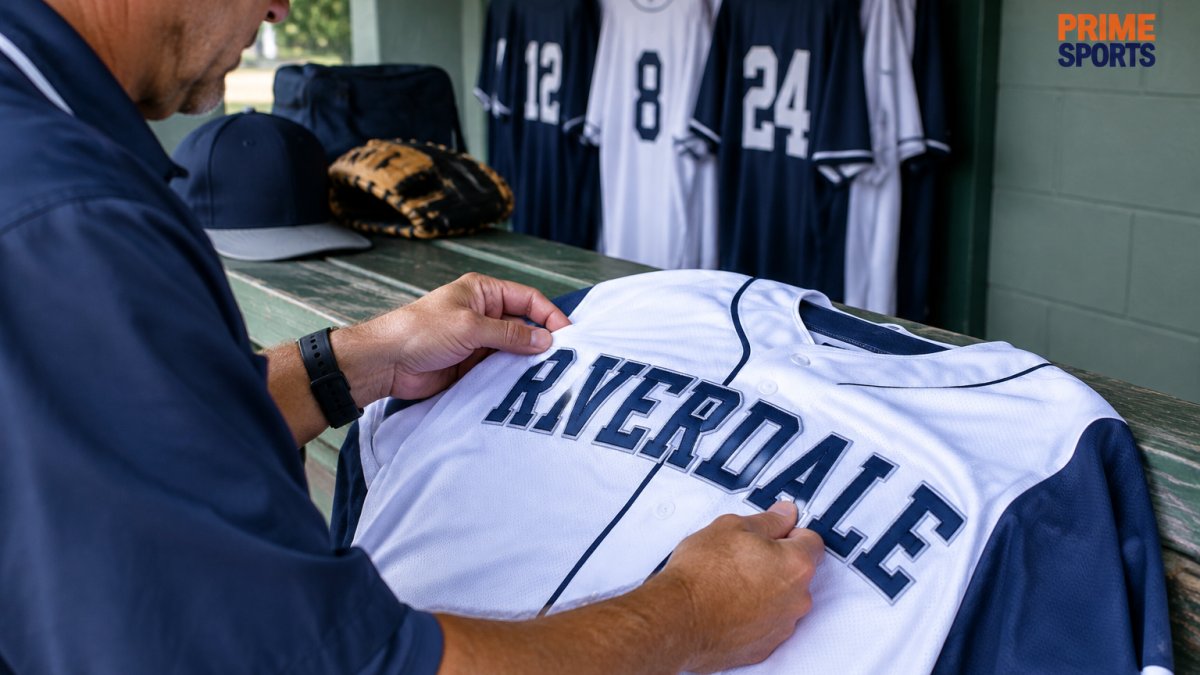
Dye sublimation dyes the design permanently into the fabric. That means colors won't fade, crack, or peel, and there are no bulky patches to sew on or come loose. Screen printing holds up well too when the ink and curing are done right, but it sits on top of the fabric rather than becoming part of it.
Professional uniforms also need to breathe. Moisture-wicking polyester keeps players and officials comfortable through doubleheaders, which matters as much for umpires as for athletes. Our durable screen-printed team uniforms guide covers what to look for in construction.
Sizing Consistency and Returns
Sizing is where most uniform programs quietly bleed money. Different manufacturers cut the same labeled size differently, so a medium from one brand fits like a large from another. Always order from a size chart tied to the specific garment, not a generic one.
Build a returns plan before you order. Ask whether exchanges are handled by the supplier or dumped back on the team manager, and confirm who pays return shipping. For coaches juggling multiple brands, our cross-brand baseball uniform sizing guide breaks down how to keep sizes straight.
How to Evaluate a Team Uniform Supplier on Total Cost
Total cost is not the sticker price on the jersey. It is the sticker price plus decoration, shipping, returns, replacement orders, and the staff hours spent chasing payments and fixing errors.
Use these seven cost lines as your comparison framework:
- Program setup and store build: any one-time fee to open an online store, load the catalog, and configure sizes and approvals. Some providers bundle this; others charge it separately.
- Garment cost: the per-item price at your actual order quantity, not the catalog list price. Ask for pricing at your real roster count, because volume breaks change the math.
- Decoration cost: per-location screen or embroidery charges, setup screens, and digitizing fees. These are frequently quoted separately and are the most common source of surprise invoices.
- Storage and warehousing: whether the supplier holds blanks and finished goods at no charge, charges per pallet or per bin, or passes storage through only during the order window.
- Pick-and-pack and handling: per-order fulfillment fees, which matter enormously for individual-ship company stores where every family receives a separate package.
- Shipping: per-order versus consolidated shipping. A team store that ships each family order individually can cost far more in aggregate than one bulk shipment to the coach, even when the per-package rate looks reasonable.
- Administration and returns: staff hours for roster management, payment chasing, size exchanges, and error correction, plus who pays return shipping and restocking.
A lower unit price from a big-box retailer often hides costs elsewhere: no team store, no consolidated shipping, and returns you handle yourself.
| Cost Factor | Low-Price Option | Full-Service Supplier |
|---|---|---|
| Setup and store build | None, but no store | Bundled or one-time fee |
| Unit price | Lower | Higher |
| Decoration | Priced separately | Bundled |
| Storage and warehousing | Team stores gear | Supplier holds blanks |
| Pick-and-pack | Team sorts and ships | Per-order fee, supplier handles |
| Shipping | Team pays per shipment | Consolidated or per-order |
| Returns handling | Team manages | Supplier manages |
| Admin hours | High | Low |
| Replacement risk | Higher | Lower |
To ground the comparison in real numbers, look at specific items. A moisture-wicking umpire polo like the Smitteez Red Line Camo shirt runs $35.00, with dye-sublimated graphics that won't crack or peel. You can also check actual apparel pricing on items like these Champro baseball pants to see where your budget lands.


Watch out: a per-item quote that excludes decoration setup, individual shipping, and return shipping is not a total cost, and comparing it to a bundled quote is comparing two different scopes. Build the seven-line model for every provider before you sign, and ask each one to confirm in writing which lines are included.
Inventory, Warehousing, and Stock Reduction for League Programs
Carrying less stock is the fastest way to cut costs without cutting quality. The old model meant buying extra jerseys in every size and storing them for years. The better model keeps inventory lean and lets the supplier hold the blanks.
Here's how league programs reduce stock:
- Use an on-demand ordering window so you produce only what's ordered
- Keep a small buffer of the most common sizes, not a full size run
- Let the supplier warehouse blanks and handle distribution
- Track stock levels against actual roster counts each season
- Route all ordering through one platform to avoid duplicate purchases
Warehousing and distribution are the supplier's job in a well-run program. When a provider handles storage, pick and pack, and shipping, your league stops renting storage space and stops writing off unsold gear.
Build Your Uniform Program With Prime Sports
The right uniform program removes the guesswork from ordering and keeps your season on schedule. Prime Sports supports youth leagues, travel teams, high schools, colleges, and businesses, offering custom jerseys, hats, spirit wear, embroidery, screen printing, and online team stores in one place.
Our online team stores support ordering for teams and families. Need custom hats or embroidery to round out the program? Our custom team hats and embroidery guide shows the options.
Get started with Prime Sports and build a uniform program that delivers on time, fits right, and holds up all season.
Frequently Asked Questions
What should teams look for in a uniform supplier?
Start with four things: a written turnaround commitment, a size chart tied to actual garment measurements rather than generic sizing, dye-sublimated or stitched graphics that hold up to repeated washing, and one point of contact who owns your order. Ask how the supplier handles returns and exchanges for sizing errors, and whether they can supply equipment alongside apparel. A supplier that only handles one piece of the puzzle leaves you coordinating the rest.
How far in advance should teams order uniforms?
Build in more lead time than the quoted turnaround. Custom apparel needs artwork approval, sizing collection from every player, and production before shipping. Collect sizes at try-on sessions, get artwork signed off in writing, and place the order with a buffer for shipping and corrections. If your season starts in spring, sizing should be finished in winter, not weeks before the first game.
Can teams order uniforms and equipment from the same supplier?
Yes, and consolidating cuts the coordination work. Prime Sports supplies baseball and softball equipment alongside custom uniforms, so bats, gloves, helmets, cleats, and protective gear can ship alongside jerseys and spirit wear. Check that the supplier stocks the specific brands and sizes your players use before you assume a single order covers everything.
What is the difference between custom uniforms and stock uniforms?
Stock uniforms come in fixed colors, designs, and size runs, so they ship faster but limit your look and often sell out mid-season. Custom uniforms are built to your colors, logos, and roster, which takes longer but gives you consistent branding across every team in the program. For a league where teams need to look uniform on and off the field, custom is usually worth the extra lead time.
