


Baseball Uniform Sizing Across Brands: A Coach's Guide
Last Updated: November 2, 2026
Quick Summary
Baseball uniform sizing across brands is inconsistent because each manufacturer builds its size charts from its own fit block, not a shared industry standard, so a youth medium from one brand can measure like a youth large from another. Measure garments flat and compare chest width, body length, and waist in inches rather than trusting size labels.
- Measure the jersey flat, not the player, for chest width, body length, and sleeve length.
- Youth XL is not a small adult; the jump to adult S often adds two or more inches.
- Size each piece, jersey and knicker, from its own chart.
- When between sizes, size up for pullover jerseys and knicker pants.
- Order one sample jersey and measure it flat before committing the whole roster.
Table of Contents
- Why Baseball Uniform Sizing Across Brands Never Matches
- How to Measure for a Baseball Jersey the Same Way Every Time
- Youth Baseball Uniform Size Chart: Reading It Correctly
- Adult Sizing and Button-Up Versus Pullover Jersey Fit
- Baseball Pants Size Chart: Waist, Inseam, and Knicker Length
- Baseball Uniform Measurement Form Every Team Should Use
- How to Compare Charts and Choose Sizes for Your Team Order
- Frequently Asked Questions
Why Baseball Uniform Sizing Across Brands Never Matches
Baseball uniform sizing across brands is inconsistent because each manufacturer builds its size charts from its own fit block, not a shared industry standard.
"Size" is a label, not a measurement.
Three things drive the mismatch:
- Fit block. Some makers cut jerseys loose for layering. Others cut them close to the body.
- Style. Button-up jerseys and pullover jerseys sit differently even in the same labeled size.
- Youth versus adult scaling. Youth sizing does not scale up in a straight line, so a youth XL is not a small adult.
The American Apparel & Footwear Association sizing guidance notes that apparel sizes are voluntary, not regulated. No one forces brands to match.
So the fix is not a better chart. The fix is measuring the same way every time and comparing numbers, not letters.
How to Measure for a Baseball Jersey the Same Way Every Time
Learning how to measure for a baseball jersey comes down to one rule: measure the garment flat, not the player. A flat garment measurement gives you a fixed number you can hold against any brand's chart.
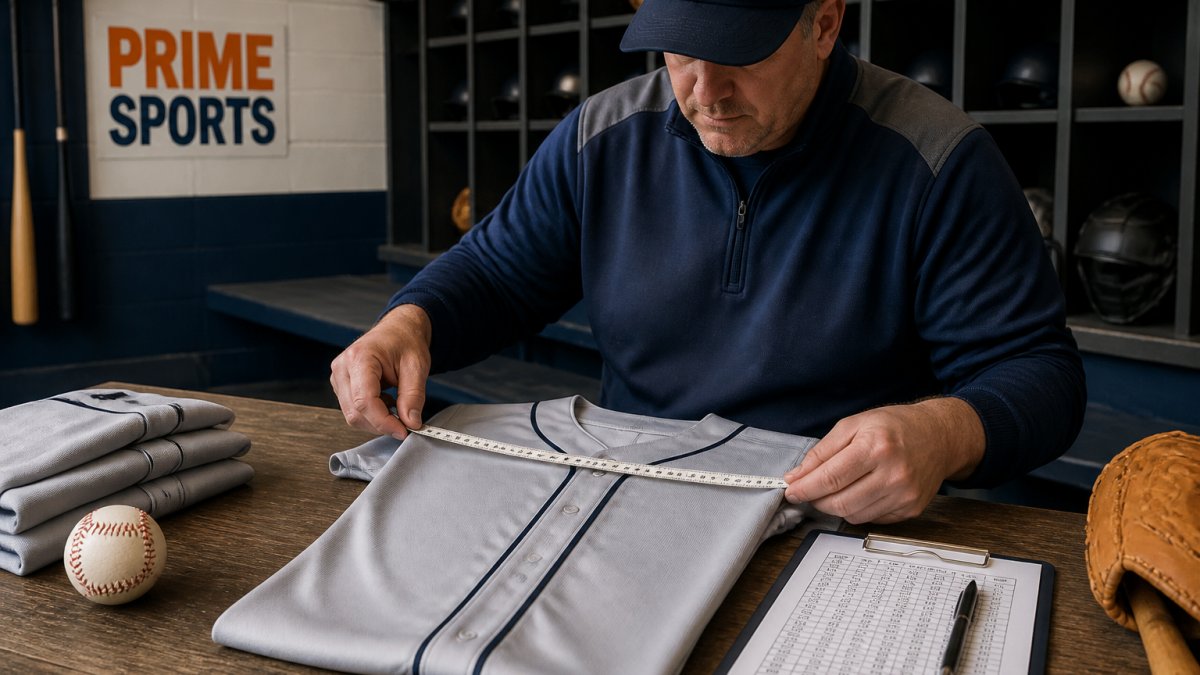
Lay the jersey flat on a table. Smooth the wrinkles. Then take three numbers:
- Chest width: armpit to armpit, straight across.
- Body length: from the top of the shoulder seam to the bottom hem.
- Sleeve length: from the shoulder seam to the sleeve end.
Write each number down in inches. Do not round. Consistency beats precision here.
Chest Width From Armpit to Armpit
Chest width is the single most useful number in baseball uniform sizing. Measure from the seam under one arm straight across to the seam under the other arm.
Keep the tape level. A sagging tape adds an inch that is not there.
Double the chest width to get the full chest circumference. That number tells you whether a player can swing freely.
Body Length and Garment Measurements
Body length tells you where the jersey ends. Measure from the highest point of the shoulder down to the hem.
A jersey that ends above the belt will ride up when the player reaches overhead.
Garment measurements beat body measurements for ordering. You can measure a jersey that already fits. You cannot always measure a growing player accurately.
Youth Baseball Uniform Size Chart: Reading It Correctly
A youth baseball uniform size chart maps age and body measurements to a size label, but the label is only a starting point. Read the chest and length columns first, then treat the age range as a rough filter, never the deciding number.
Here is the pattern we see most often across youth lines:
| Size Label | Typical Chest Width (flat, armpit to armpit) | Typical Body Length (shoulder to hem) | Typical Age Range |
|---|---|---|---|
| Youth S | 15-16 in | 20-21 in | 6-8 |
| Youth M | 16-17 in | 22-23 in | 8-10 |
| Youth L | 17-18 in | 24-25 in | 10-12 |
| Youth XL | 18-19 in | 26-27 in | 12-14 |
| Adult S | 19-20 in | 28-29 in | 14 and up, or smaller adults |
Treat these as reference points, not gospel. To check youth measurements against a real product, see the Youth Alleson Knicker page.
Why Age-Based Sizing and Youth-to-Adult Conversions Fail
The most common youth sizing error is ordering by age.
The second error is assuming youth sizes scale into adult sizes in a straight line.
A third pitfall: youth knickers and youth jerseys from the same maker do not always scale together. A youth large jersey may pair with a youth medium knicker on the same player. Size each piece from its own chart.
Growth Room Without a Midseason Reorder
A jersey with no room to grow is a midseason reorder, but over-sizing creates its own problems: a jersey two sizes too big hangs off the shoulders, catches on the swing, and looks wrong on picture day. Size for the chest now and accept a possible reorder next season rather than sizing two years ahead. If you must plan for growth, add room in body length before chest width, because length is easier to live with and easier to tuck.
Midstopper Above the Knee Youth Knicker Baseball Pant →
Adult Sizing and Button-Up Versus Pullover Jersey Fit
Adult baseball uniform sizing splits into two families: button-up jerseys and pullover jerseys. They do not fit the same, even when the chart says they do.
A few fit notes that most charts skip:
- Relaxed fit jerseys sit looser through the body. Good for pitchers who want a free arm path.
- Oversized fit is a style choice, not a size mistake. Order your normal size, not a size up.
- Layering matters. A jersey worn over a hoodie in cold weather needs extra room.
Baseball Pants Size Chart: Waist, Inseam, and Knicker Length
A baseball pants size chart runs on waist and inseam, and knicker length changes the inseam number entirely.
Waist measurement is the most important number. Measure where the player wears the pants, not at the belly button.
Then decide the style:
- Full-length pants reach the shoe. Inseam runs long.
- Knicker pants end below the knee or above it. Inseam runs short by design.
Knicker length varies by maker too. You can see actual sizing details on the Adult Alleson Knickers W Braid product page.
The Midstopper knickers run small, so check the size chart before ordering and size up if a player is between sizes.
A knicker that lands too high looks wrong and rides up; one that lands too low defeats the style.
Baseball Uniform Measurement Form Every Team Should Use
A baseball uniform measurement form turns guesswork into one clean sheet. For practical advice on organizing and tracking youth uniforms, read How to Organize Youth Baseball Uniforms: A Coach's Guide. Collect the same fields for every player and you can size a whole roster without chasing parents for numbers.
Use this checklist for each player:
- Player name and jersey number
- Chest width, armpit to armpit, in inches
- Body length, shoulder to hem
Between-Size Decision Rules Using Actual Measurements
When a player lands between two sizes, use these rules instead of guessing:
- Chest within half an inch of the larger size: size up.
- Pullover jersey and between sizes: size up.
- Button-up jersey and between sizes: stay at the smaller size if the chest clears.
Write the decision next to the player's name on the form. That way, when a reorder happens, no one has to re-measure.
How to Compare Charts and Choose Sizes for Your Team Order
Comparing charts across brands works when you line up the same three numbers: chest width, body length, and waist. Ignore the size labels. Compare the inches. This is the step most sizing guides skip, and it is the step that prevents the box of returns. Before committing to a custom order, read Why Custom Team Uniforms Cost More.
Build a Normalized Comparison Sheet
A normalized comparison sheet puts every brand on the same measurement basis so you can see, at a glance, which label in Brand B matches the label you already trust in Brand A.
| Measurement (flat, in) | Brand A, M | Brand A, L | Brand B, M | Brand B, L | Your Player |
|---|---|---|---|---|---|
| Chest width (armpit to armpit) | 17 | 18 | 18 | 19 | 17.5 |
| Body length (shoulder to hem) | 24 | 25 | 25 | 26 | 24 |
| Waist | 26 | 28 | 27 | 29 | 26 |
Read the sheet by row, not by column. Above, the player's 17.5-inch chest sits between Brand A's medium and large but matches Brand B's medium exactly, while the 24-inch body length matches Brand A's medium and is an inch short of Brand B's medium.
A Consistent Measurement Protocol for Comparing Charts
The comparison only works if every number on the sheet was taken the same way. Two rules make that happen:
- Separate body measurements from garment measurements. A body measurement is taken around the player; a garment measurement is taken flat on a jersey. Comparing a body chest circumference to a flat garment chest width will make every jersey look too small, so convert one to the other first: double the flat chest width to get circumference, or halve the body circumference to get flat width.
- Fix the tape landmarks. Chest width is armpit seam to armpit seam, straight across, tape level. Body length is the highest point of the shoulder seam to the bottom hem. Waist is around the waist where the player wears the pants, not at the belly button. Write the landmark next to every number so a parent measuring at home produces the same number a coach would.
Account for Measurement Uncertainty and Chart Limitations
No chart is exact, and treating it as exact causes as many errors as ignoring it. Three sources of uncertainty are worth building into your order:
- Manufacturing tolerances. Cut-and-sew garments vary from unit to unit, commonly by roughly half an inch in chest width and body length on either side of the stated spec. Two jerseys in the same labeled size can measure differently.
- Shrinkage and stretch. Cotton-rich jerseys can shrink after washing; performance fabrics tend to hold their size or stretch slightly with wear. A jersey that fits out of the bag may fit differently after a month of wash cycles.
- Chart drift. Makers revise fit blocks and charts between seasons without changing the label. Verify the current product-specific chart before ordering, and note the date you checked it on your comparison sheet.
Practical Rules for the Team Order
- Order samples first for any new brand or style. One jersey tells you more than any chart.
- Keep one master sheet for the whole team, with the measurement protocol written at the top so every parent measures the same way.
- Note the maker, style, and chart date next to each size. A "large" means nothing without that context.
Prime Sports offers custom uniforms and team stores with screen printing, embroidery, and sublimation services.
Frequently Asked Questions
Can you use one brand's size chart to choose another brand's uniform?
No. Baseball uniform sizing across brands is not interchangeable, even when the labeled sizes look the same. A youth large from one maker can run a full size smaller than a youth large from another. Always pull the specific chart for the exact jersey or pant you are ordering, and compare it against measured chest, waist, and inseam numbers rather than age or the size a player wore last season. When a player falls between two sizes, check that brand's guidance before deciding.
How do youth baseball uniform sizes compare with adult sizes?
Youth and adult ranges overlap at the top, but the grading is different. Youth sizes are cut shorter in body length and narrower through the chest, while adult sizes add length and room through the shoulders. A player moving up often needs a smaller adult size than expected, not the largest youth size. Measure chest width armpit to armpit and body length, then match those numbers to the adult chart rather than guessing from age or grade.
How do you choose a baseball uniform size if a player is between sizes?
Use the measurement that affects movement most. For jerseys, size up if the chest measurement lands between two sizes so the player can swing without binding. For pants, follow the maker's guidance, since some cuts are designed to fit tighter at the thigh. The Midstopper knicker line, for example, runs small and the maker recommends sizing up between sizes. Always record the actual measurement on your form so the decision is documented.
Should players try on baseball uniforms before a team order?
Measuring every player with a consistent protocol and submitting the numbers on one form gives you a defensible record and helps cut down on returns once the full order arrives.
