
Why Custom Team Uniforms Cost More
Table of Contents
- What Drives the Price of Custom Team Uniforms
- Custom Team Uniform Cost Breakdown
- Custom Uniforms vs. Standard Uniforms: Where the Money Goes
- How Bulk Team Uniform Orders Affect Per-Player Pricing
- Hidden Costs in Cheap Team Uniforms
- Total Cost of Ownership Over Multiple Seasons
- How to Compare Uniform Quotes and Avoid Surprises
- Frequently Asked Questions
Last Updated: October 14, 2026
What Drives the Price of Custom Team Uniforms
Custom team uniforms cost more than standard apparel because every element, fabric, decoration, minimums, adds expense stock uniforms don't have.
You're paying for personalization at scale: setup costs, design work, and production runs tailored to your specs.
The real cost drivers break down into a few clear categories:
- Base garment quality, Performance fabrics cost more than basic cotton
- Decoration methods, Sublimation, embroidery, and screen printing each have different price structures
- Customization complexity, More colors, intricate designs, and personalization increase labor
At Prime Sports, we help teams understand where their budget goes. Most coaches are surprised the base garment is often the smallest part of the total cost, decoration and customization are where expenses multiply.

Custom Team Uniform Cost Breakdown
Here's what you're actually paying for:
Base Garment and Fabric Selection
The starting point is the blank garment itself, not a $5 discount-bin t-shirt. Moisture-wicking polyester blends run higher than cotton, and breathability and durability add manufacturing complexity so the uniform survives a full season.
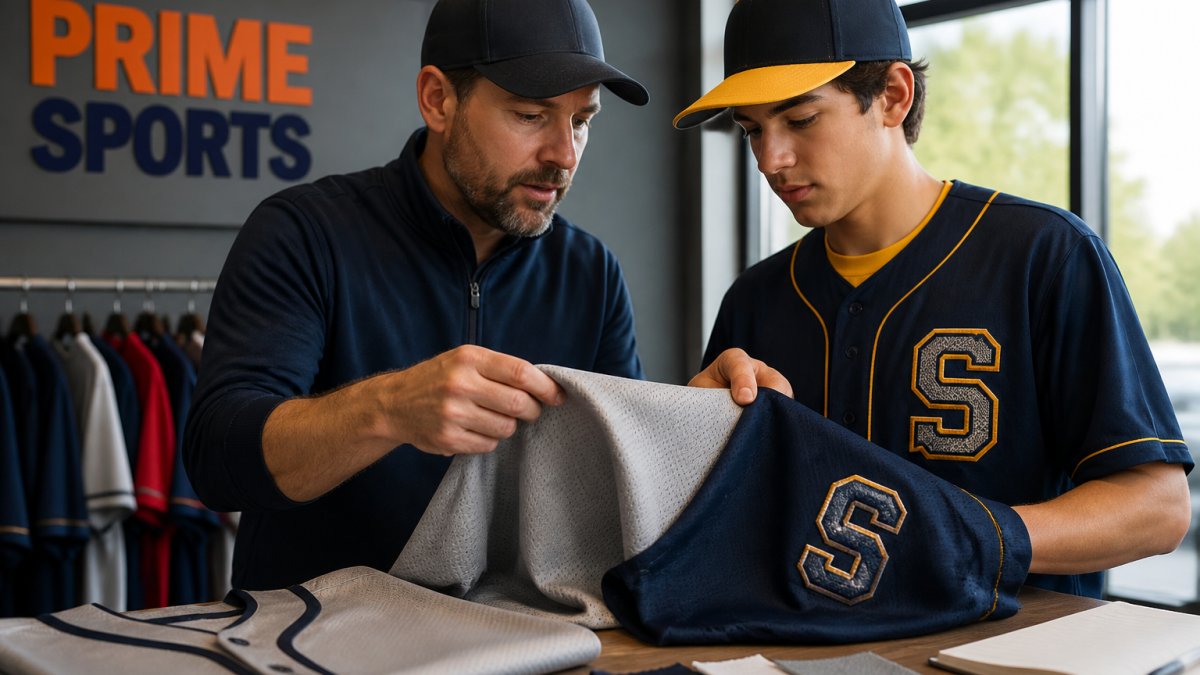
Consider the Original Dirty Mids baseball pants from Prime Sports.

Decoration Methods and Complexity
How you add names, logos, and numbers dramatically affects price:
Screen printing suits simple designs. A single-color print on 20 jerseys costs less per unit than embroidery, but a second color raises setup fees, the printer separates artwork into layers and creates a screen for each.
Embroidery costs more per unit but looks premium: thread costs more than ink, labor takes longer, and logos don't fade or crack like prints.
Sublimation allows full-color, photorealistic designs ideal for complex logos or gradients. The trade-off is higher per-unit cost and longer production time; dyes bond directly to polyester, so it works best on performance materials.
Most teams combine methods, embroidered logo, screen-printed names, sublimated numbers, and that flexibility costs more than one simple approach.
Setup Fees and Minimum Orders
Decoration vendors charge setup fees, sometimes $50-$200 per design, to create production files, test samples, and prepare equipment for your job.
Minimum order quantities also drive per-unit cost up. A vendor might require 12 units for embroidery or 24 for screen printing; needing only 15 means paying for 24 or absorbing a small-run penalty. Minimums exist because setup time is the same whether you order 12 units or 100, at 100 units the setup spreads across more pieces.
Custom Uniforms vs. Standard Uniforms: Where the Money Goes
Standard uniforms are off-the-shelf apparel produced in bulk without customization, then sold to retailers, completely different economics from custom orders.
A stock uniform might cost $20-$40 per piece because the manufacturer amortizes design, tooling, and setup across thousands of identical units. You pay retail markup, but the base cost is low.
With custom uniforms, you're paying for:
- Design and artwork, Someone creates your unique design
- Production setup, Equipment configured specifically for your job
- Quality control, Inspection for your specifications, not generic standards
The trade-off is worth it for team identity and fit: standard uniforms come in generic colorways and basic sizing, while custom uniforms match your exact colors, include player personalization, and fit your roster's size distribution.
How Bulk Team Uniform Orders Affect Per-Player Pricing
Order quantity dramatically affects per-unit cost, but the number that matters isn't your roster size, it's roster size plus the extras you'll almost certainly need. A 15-player order might have a certain per-uniform cost; larger orders generally see a reduction in that cost.
Here's why bulk orders reduce per-player cost:
- Setup fees spread thin, A $100 setup fee on 15 units is $6.67 per uniform. On 50 units, it's $2 per uniform.
- Better pricing from vendors, Larger orders qualify for volume discounts on base garments and decoration.
- Efficiency in production, Running 50 identical jerseys is faster per unit than running 15. Labor cost per piece drops.
If you're ordering for multiple teams or a full league, consolidating dramatically improves pricing, one central order for 100 uniforms beats five separate 20-piece orders.
Why Your Real Order Quantity Is Bigger Than Your Roster
A 20-player roster doesn't translate to a 20-piece order. The practical quantity is almost always larger, and that gap is where per-player cost quietly rises.
Original Dirty Mids The Essential Baseball Pants →
- Size runs. A roster of 20 might need 2 XS, 4 S, 6 M, 5 L, 2 XL, and 1 2XL. Some sizes sell out or carry vendor minimums, and odd sizes can cost more per unit.
- Sizing uncertainty. Youth players grow mid-season and adults misjudge fit, so ordering one or two extras of common sizes is standard, billed at the same per-unit rate.
- Sample and fit kits. Many vendors offer try-on sets; some credit the kit back, some don't. Ask which.
The Cost of Adding Players After the Initial Order
Late adds are the most common hidden cost in team uniform ordering, a player joins mid-season and you need one more jersey in an unstocked size. A single-piece reorder typically carries a per-order setup or digitizing fee already absorbed in the original bulk run, higher per-unit garment pricing because one piece doesn't qualify for volume rates, shipping on a single item that can rival the garment's cost, and a production slot that may not align with the vendor's schedule.
How Roster Size Changes the Math
| Roster size | Practical order quantity | Per-player effect |
|---|---|---|
| 12-15 players | 15-18 pieces with spares and staff | Highest per-player cost; setup fees spread across fewest units |
| 20-30 players | 24-36 pieces | Mid-range; volume discounts begin to apply |
| 40-60 players | 48-70 pieces | Lower per-player cost; worth consolidating across teams |
| 80+ players | 90+ pieces | Best per-player pricing; league-wide orders unlock the deepest discounts |
Consolidating Across Teams and Leagues
The biggest lever on per-player cost isn't negotiating, it's consolidating. Eight teams of 20 ordering 160 uniforms in one run instead of eight separate 20-piece runs can move pricing from mid-range to the lowest tier. The catch is coordination: one contact, one artwork approval, one delivery date, one set of size runs. Leagues that do this consistently report lower per-player costs than teams ordering independently.
What to Confirm Before You Commit to a Quantity
- The vendor's exact minimum order quantity and what happens if you fall below it.
- Whether spare and staff pieces are billed at the same per-unit rate as the roster.
- The cost of a single-piece reorder, in writing.
Getting those five answers before you sign turns a bulk order into a plan and keeps your quoted per-player price from creeping up.
Hidden Costs in Cheap Team Uniforms
Budget uniforms often hide costs that appear later.
No customization support. Cheap vendors often won't adjust designs or handle special requests, you get what's offered.
Hidden fees, Rush fees, sizing adjustments, or returns aren't included in the quoted price. The final invoice is higher than expected.
A $35 uniform that lasts one season and needs replacing next year costs $35 plus replacements.
Total Cost of Ownership Over Multiple Seasons
Looking at custom team uniforms over their lifespan changes the math.
A quality custom uniform with proper fabric and decoration lasts 2-3 seasons, so a $60 uniform costs $20-$30 per season.
Budget uniforms last one season. A $35 uniform is $35 per season.
Over multiple seasons, the total cost of ownership can vary significantly between quality and budget uniforms.
Replacement costs matter too: replacing one quality piece mid-season is cheaper than replacing a whole budget set, which often can't be partially replaced.
How to Compare Uniform Quotes and Avoid Surprises
Most vendors quote a single per-uniform price that hides everything that matters. Two quotes both saying "$48 per uniform" can land $600 apart once setup, shipping, minimums, and taxes are added. Force every quote into the same itemized format to compare honestly.
The Itemized Quote Breakdown
Ask every vendor to break the quote into these lines. If they won't, that's your answer.
| Line item | What it covers | Typical behavior |
|---|---|---|
| Base garment | Blank jersey, short, pant, or shell at your chosen fabric and weight | Scales down with quantity; the most comparable line across vendors |
| Decoration | Per-piece charge for sublimation, screen print, embroidery, or a mix | Varies most by method and color count |
| Artwork / setup | Digitizing, screen creation, file prep, proofing | Often a one-time fixed fee, sometimes waived on reorders |
| Minimum order charge | Penalty or forced overage when you fall under the vendor's MOQ | Frequently buried in the per-unit price |
| Sizing and sample kit | Fit samples, size-run setup, or a try-on set | Sometimes free, sometimes billed and credited back |
| Shipping and handling | Freight, split shipments, drop-ship to individual players | Rarely included in the headline price |
| Rush / expedite | Compressed production or upgraded freight | The single most common surprise line |
| Taxes and duties | Sales tax, and any import charges on overseas blanks | Depends on your state and the vendor's sourcing |
Worked Example: Two Quotes, Same Headline Price
When comparing quotes, it's important to look beyond the headline price. Different vendors may structure their pricing with varying fees for artwork, shipping, and samples. A seemingly lower per-uniform price from one vendor might result in a higher total landed cost per player once all additional charges are factored in, making a seemingly more expensive quote the better value.
Questions That Expose Hidden Fees
- What is the minimum order, and what happens if we fall below it? Some vendors round you up and bill for extras; others add a small-order surcharge. Only one is usually disclosed up front.
- Is the artwork fee one-time or per order? A one-time digitizing fee that carries to reorders differs from a per-run setup charge.
- What does a reorder cost? Ask whether reorders carry the same setup fee, a reduced one, or none.
The Quote-Comparison Checklist
Use the same checklist for every vendor:
- Fabric spec, fiber content, weight, and stretch, written down, not "performance poly."
- Decoration method and color count, sublimation vs. screen print vs. embroidery, and how many colors or thread changes.
- Package contents, what pieces are included per player (jersey only? jersey + short? warm-up? socks?).
- Setup and artwork fees, one-time or recurring, and whether they carry to reorders.
- Minimum order and small-order treatment, the exact threshold and the exact penalty.
- Sizing and sample policy, is a size kit provided, and is it credited back?
- Delivery date in writing, production start, ship date, and in-hands date, with a stated remedy if the vendor misses.
- Warranty, what the vendor guarantees on decoration durability and construction, and for how long.
- Landed cost per player, the single number you actually compare.
Federal Trade Commission guidance on advertising and pricing claims
Red Flags in a Quote
- A single per-uniform price with no line items.
- "Setup included" with no reorder explanation.
- A minimum order revealed only after you share your roster size.
A vendor who itemizes, puts dates in writing, and quotes reorders up front is almost always safer, even at a higher headline number. The ones who won't are the ones whose final invoice surprises you.
Frequently Asked Questions
How much does a custom team uniform typically cost per player?
Custom team uniform pricing varies based on fabric quality, decoration method, and order size. Bulk orders generally reduce the per-player cost compared to smaller orders. Setup fees are divided across the order, so larger teams benefit from lower per-unit costs.
Why do custom uniforms cost more than stock apparel?
Custom uniforms cost more because they involve personalization, higher-quality fabrics, and specialized production. Stock uniforms are mass-produced with standard sizing and no customization. Custom uniforms require design artwork, setup fees for decoration equipment, sizing variety to fit different body types, and quality control to ensure durability through a full season. You're also paying for the ability to add team colors, logos, player names, and numbers, features that stock apparel doesn't offer.
What hidden costs should I watch for when ordering cheap team uniforms?
Cheap team uniforms often hide costs in setup fees, rush charges, sizing exchanges, and durability issues. Low-cost options may use thin fabrics that fade or tear easily, requiring replacement mid-season. Hidden fees include artwork charges, number placement fees, and expedited shipping. Poor stitching and low-quality decoration methods (like vinyl that cracks) result in uniforms that don't survive a full season, forcing you to reorder. Always request an itemized quote that shows every fee upfront.
Do bulk team uniform orders really reduce the cost per player?
Yes, bulk orders significantly reduce per-player cost. The savings come from spreading setup fees across more units and qualifying for volume discounts on fabric and decoration. However, larger orders require accurate sizing data upfront to avoid costly returns, so confirm your roster and sizing before committing to a bulk order.