


How to Organize Youth Baseball Uniforms: A Coach's Guide
Table of Contents
- Why Uniform Organization Matters for Youth Baseball Teams
- Understanding Youth Baseball Uniform Sizing Charts
- Building an Inventory Tracking System for Team Gear
- Team Uniform Distribution Checklist and Protocols
- Baseball Jersey Care Instructions and Maintenance
- Organizing Equipment and Accessories Alongside Uniforms
- End-of-Season Uniform Collection and Off-Season Storage
- Frequently Asked Questions
Last Updated: October 2, 2026
Why Uniform Organization Matters for Youth Baseball Teams
Learning how to organize youth baseball uniforms is where most youth baseball programs stumble.
Proper uniform organization starts before you even place an order and continues through the end of the season.
When you organize youth baseball uniforms correctly, you reduce waste, improve team identity, and save money on replacements.
This guide walks you through every step of organizing youth baseball uniforms, from measuring players accurately to storing gear properly after the season ends.
Understanding Youth Baseball Uniform Sizing Charts
The biggest mistake coaches make is assuming a sizing chart works the same way across different manufacturers. It doesn't.
A youth baseball uniform sizing chart is a reference guide that matches player measurements to garment sizes. But here's the problem: one company's medium might run small, another's runs large, and a third's is somewhere in between. Without a clear process, you end up with uniforms that don't fit, frustrated parents, and wasted money on returns.
Start by selecting your uniform vendor early. Ask for their specific sizing chart, not a generic one. Get actual measurements from each player:
- Chest: Measure around the fullest part of the chest
- Waist: Measure at the natural waist level
- Sleeve length: Measure from the center back neck to the wrist
- Inseam: Measure from the inside of the thigh to the ankle
How to Measure Players Accurately
Take measurements in person whenever possible. A parent guessing at their kid's chest size is the leading cause of sizing problems.
Use a soft measuring tape, not a ruler. Have the player stand relaxed in a t-shirt, not bulked up in winter gear.
Round up slightly for growing kids. A youth player might be between sizes, and a slightly loose uniform beats one that's too tight.
Common Sizing Mistakes to Avoid
Don't trust parent estimates. Parents think they know their kid's size. They're often wrong by a full size in either direction.
Never order all uniforms at once without a sample. Get a few jerseys in different sizes from your vendor, have players try them on, and adjust your sizing before the full order.
Avoid mixing manufacturers within a single team. If you're ordering practice gear from one vendor and game jerseys from another, their sizing will be different.
Building an Inventory Tracking System for Team Gear
You can't manage what you don't measure. Without a tracking system, you'll lose jerseys, forget who has what, and struggle to account for gear at season's end.
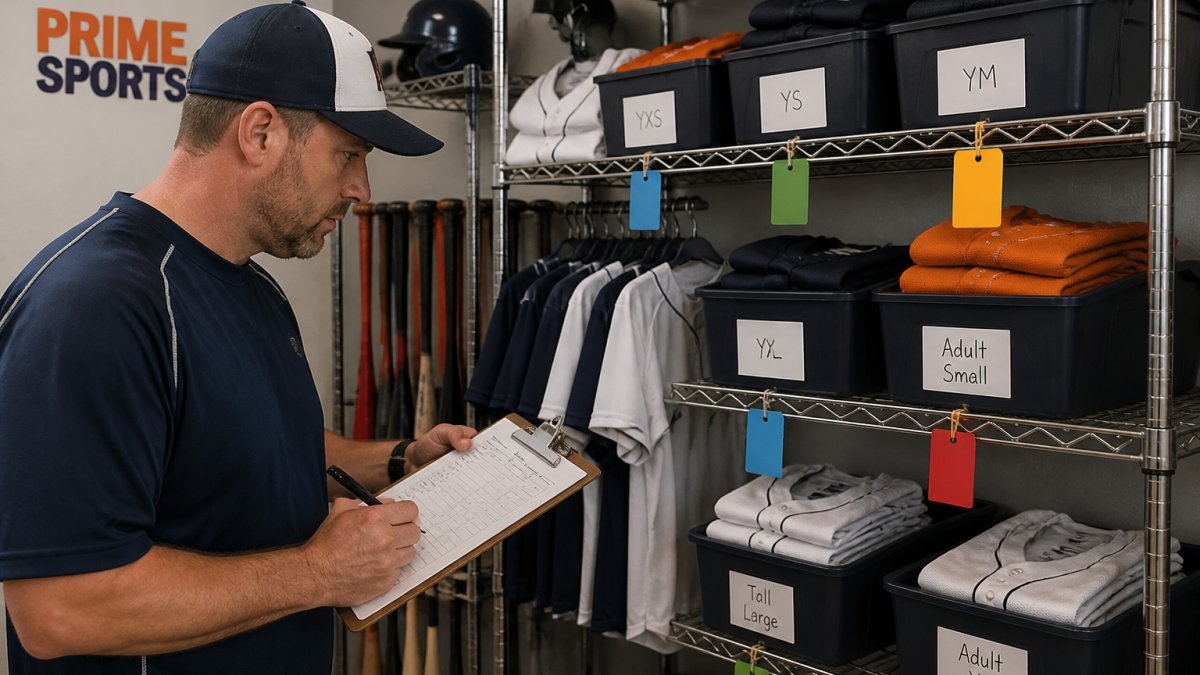
An inventory system doesn't need to be complicated. At its core, it answers three questions: What do we have? Who has it? What condition is it in?
Start with a simple spreadsheet or use a free online tool. Create columns for:
- Jersey number
- Player name
- Size
- Condition at issue
- Date issued
- Date returned
- Condition at return
Update it every time a uniform changes hands. This takes 30 seconds per transaction and saves hours of headaches later.
Digital Tracking Methods
A spreadsheet works fine for small teams. For larger organizations managing multiple squads, consider a free tool like Google Forms or Airtable.
Label every piece of equipment. Use a permanent marker to write the player's number on the inside of the collar.
Take photos of your inventory before distribution. Photograph each uniform laid out with its jersey number visible.
Labeling and Identification Strategies
Color-coded labels work well for teams with multiple squads. Use different colored tape or stickers for varsity, JV, and practice gear.
Create a laminated card for each player showing their assigned sizes and jersey number. Tape it to the inside of their bag or locker. This reduces confusion and speeds up distribution.
For team gear and accessories like sliding shorts, compression shirts, and cooling towels, use a master inventory sheet.
Team Uniform Distribution Checklist and Protocols
Distribution is where your system either works or falls apart. A clear protocol prevents arguments, lost gear, and confusion about who owes what back.
Create a distribution day with a set time and place. Have players and parents come together to receive uniforms. This isn't optional, it's your chance to verify fit, explain care instructions, and collect signatures acknowledging receipt.
Pre-Distribution Verification Steps
Before distribution day, inspect every uniform. Check seams, look for stains or damage from manufacturing, and verify that all pieces are accounted for.
Organize uniforms by size, then by player name within each size. Lay them out in order so distribution moves quickly.
Have a backup plan for sizing issues. Keep extra uniforms in common sizes on hand.
Recording Player Assignments
Create a sign-off sheet. Each player or parent signs to confirm they received their uniform, understand the care instructions, and agree to return it in good condition.
Take a photo of each player in their uniform on distribution day. You now have proof of what they received and how it fit.
Record the date of issue. Track how long each uniform is in use. This helps you plan replacement cycles and budget for next season.
HIDEit 8Bat | Universal Baseball Bat Mount →
Baseball Jersey Care Instructions and Maintenance
How players care for uniforms determines how long they last. Bad laundry habits destroy gear in one season. Good habits extend the life by years.
Print care instructions and give them to every player. Include your team's specific rules: wash in cold water, turn inside out before washing, air dry (no dryer), no bleach, no fabric softener.
Washing and Stain Removal Best Practices
Treat stains immediately. Infield dirt, grass, and sweat set quickly.
For grass stains, use a stain remover stick before washing.
Wash uniforms inside out. This protects screen printing and sublimation from friction and fading. Use cold water and a gentle cycle.
Air dry everything. A dryer's heat damages elastic, warps sublimation, and fades colors. Hang jerseys on a line or lay them flat.
Extending the Life of Sublimation and Screen Printing
Sublimation is durable but not indestructible. It bonds to the fabric at a molecular level, so it won't crack or peel like screen printing.
Screen printing is more fragile. Avoid dry cleaning because the chemicals break down the ink.
Store uniforms away from direct sunlight. UV light fades both sublimation and screen printing.
Consider a protective spray for screen-printed jerseys. These products add a thin, invisible layer that protects the print from cracking.
Organizing Equipment and Accessories Alongside Uniforms
Uniforms are just one piece. Players also need sliding shorts, compression shirts, protective gear, and other accessories.
Create a team gear kit for each player.
Track accessories the same way you track jerseys. Sliding shorts wear out quickly, so budget for replacements mid-season.
Keep backup gear on hand. A torn jersey, a lost sliding short, or a broken belt shouldn't sideline a player.
Use the EvoShield Takeover Wheeled Bag or DeMarini Spectre V2 Backpack to organize and transport team gear to games. These bags keep equipment organized, protect gear from damage, and make it easy to move everything to the field. For coaches managing equipment, a wheeled bag eliminates the hassle of multiple trips and keeps all team gear in one place.

End-of-Season Uniform Collection and Off-Season Storage
The season ends and uniforms disappear. Without a collection protocol, you'll never see half of them again.
Schedule a uniform return day. Make it mandatory. Give players a specific date and time to return all gear. Explain that unreturned uniforms result in fees charged to the player or parent.
Creating a Return and Inspection Process
When uniforms come back, inspect them immediately. Check for stains, tears, fading, and wear. Document the condition of each piece.
Have a cleaning station. Wash returned uniforms before storage. Remove stains, clean dirt, and eliminate odors. A uniform that smells like a gym bag will mildew in storage.
Repair minor damage before storage. A small tear becomes a big problem after sitting for months.
Proper Storage Conditions and Methods
Store uniforms in a cool, dry place. Basements work if they're not damp.
Use plastic bins with lids to keep out dust, insects, and moisture.
Add cedar blocks or lavender sachets to prevent musty smells.
Hang uniforms on hangers if you have the space.
Check storage bins once during the off-season.
Organizing youth baseball uniforms isn't glamorous, but it's essential.
Prime Sports helps coaches and organizations simplify the entire uniform process.
Frequently Asked Questions
How do you effectively collect and distribute uniform sizes for a team?
Start by measuring each player's chest, waist, and inseam using a soft measuring tape. Have players wear fitted clothing during measurement. Create a spreadsheet with player names, positions, and measurements, then cross-reference it with your youth baseball uniform sizing chart from your custom apparel provider. Collect all sizes at once rather than piecemeal to ensure consistency. Assign a single person to verify measurements and flag any outliers before ordering.
What is the best way to label youth baseball jerseys to prevent loss?
Use permanent markers or iron-on labels with player names and numbers on the inside neckline and back waistband. Create a master inventory list that maps each jersey to a specific player. Consider adding small colored tape or stickers to distinguish between practice and game jerseys. For sliding shorts, compression shirts, and other gear, label them consistently so you can quickly identify missing items at season's end. This tracking system prevents confusion during team uniform distribution and makes end-of-season collection easier.
How should you store team uniforms during the off-season?
After washing and inspecting all jerseys and apparel, store them in a cool, dry place away from direct sunlight to prevent fading. Use breathable garment bags or sealed plastic bins with moisture-absorbing packets to prevent mold and mildew. Hang jerseys on padded hangers rather than folding to maintain shape. Store protective gear like sliding shorts and cooling towels separately in ventilated containers. Keep an inventory list with the storage location and condition notes so you know exactly what's available when the next season starts.
What are the essential parts of a baseball uniform that need organizing?
A complete youth baseball uniform includes jersey, pants, socks, sliding shorts, compression shirts, and a hat or cap. Many teams also manage batting helmets, fielding gloves, cleats, and protective gear like chest protectors for catchers. Use the team uniform distribution checklist to ensure every player receives all required pieces. Organize these items by player assignment or by type (all jerseys together, all pants together) depending on your storage space and how frequently items need to be accessed during the season.