


7 Steps to Choose the Right Youth Baseball Bat
Last Updated: November 1, 2026
Quick Summary
To choose the right youth baseball bat, start with your league's certification rules, then match bat length to the player's height and weight using a size chart and confirm the fit with the standing test. Pick the lightest drop weight your player can swing fast without losing control.
- Check the league's certification stamp, barrel size, and drop limits before buying any bat.
- In the standing test, the bat knob should land between the ground and the player's hip.
- T-ball and coach pitch bats run from -13 to -10 drop; high school standard is -3.
- Alloy bats resist dents, handle cold weather, and cost less than composite bats.
- Compare at least two models at the same size, because feel is the tiebreaker.
Table of Contents
- Start With the League Rules, Not the Bat
- Youth Baseball Bat Size Chart: Match Length to Height and Weight
- How to Measure a Child for a Baseball Bat
- Youth Baseball Bat Drop Weight: Why the Minus Number Matters
- USSSA Baseball Bat Rules and Other Certifications to Check
- Pick the Right Material: Alloy, Composite, or Wood
- Your Bat Buying Checklist and Where to Shop
- Frequently Asked Questions
Start With the League Rules, Not the Bat
Most parents start bat shopping the wrong way. They walk into a store, pick up a bat that feels light, and buy it. Then the first practice arrives and a coach says it's not legal for the league.
That's an expensive mistake. The right way to choose the right youth baseball bat is to start with the rulebook, not the rack.
Every league sets its own bat standards. USA Baseball, USSSA, and NFHS high school rules all differ on barrel size, certification stamps, and drop weight limits. A bat that crushes it in one league can be banned in another.
So before you spend a dollar, answer three questions:
- Which league does my player compete in?
- What certification stamp does that league require?
- Are there age-based barrel or drop restrictions?
Get those answers first. Everything else in this guide builds on them.
Youth Baseball Bat Size Chart: Match Length to Height and Weight
A youth baseball bat size chart gives you a starting point, not a final answer. Use height and weight to find a length range, then confirm the fit in person.
Here's a practical reference chart for youth players:
| Player Height | Player Weight | Suggested Bat Length |
|---|---|---|
| Under 4'0" | Under 60 lbs | 26"-27" |
| 4'0"-4'4" | 60-80 lbs | 27"-28" |
| 4'4"-4'8" | 80-100 lbs | 28"-29" |
| 4'8"-5'0" | 100-120 lbs | 29"-30" |
| 5'0"-5'4" | 120-140 lbs | 30"-31" |
| 5'4"-5'8" | 140-160 lbs | 31"-32" |
Weight matters as much as height. A tall, thin player often swings a shorter bat better than a longer one. A stocky player can handle more length.
Treat the chart as a filter. It narrows the shelf to two or three options. The measurement test below picks the winner.
How to Measure a Child for a Baseball Bat
The best way to measure a child for a baseball bat is the standing test: have the player stand tall with arms at their sides, then rest the bat knob on the ground beside their front foot. The bat's knob should land between the ground and the player's hip.
Here's how to run it properly:
- Have the player stand in cleats or athletic shoes on a flat surface.
- Hold the bat vertically at their side, knob touching the ground.
- Check where the knob sits. Between the ground and the hip is the target zone.
- If the knob reaches above the hip, the bat is too long.
- If the knob barely clears the ground, the bat is too short.
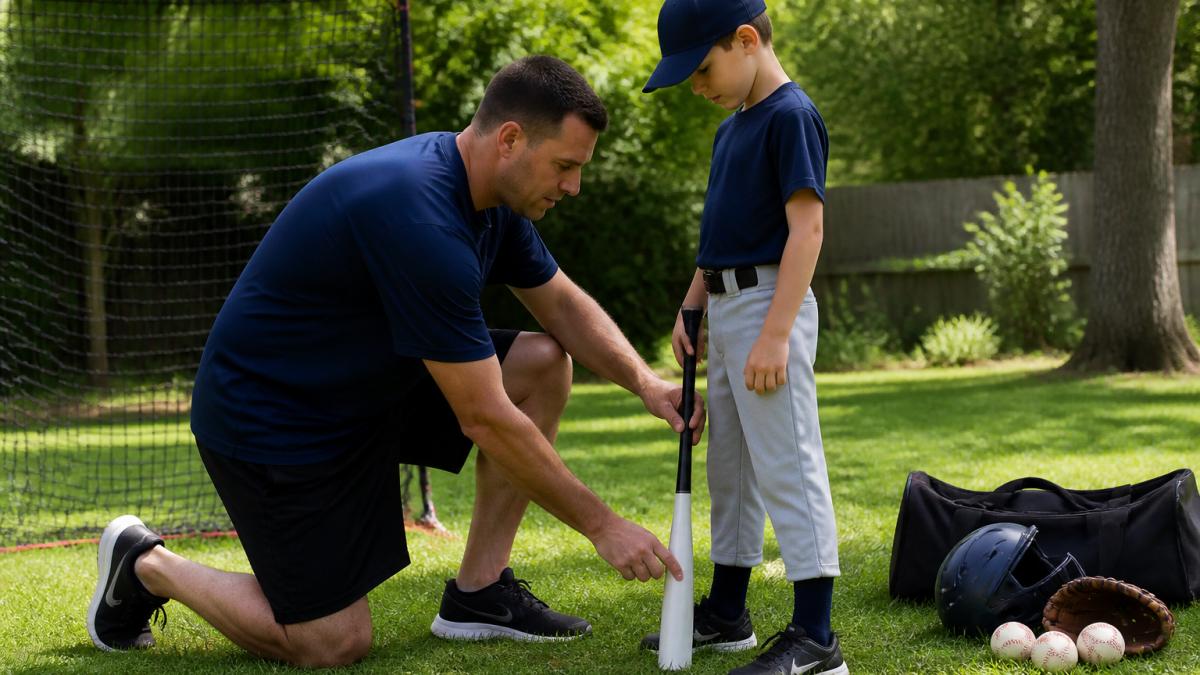
Then run the control test. Have the player grip the bat normally and extend one arm straight out to the side. A player with good bat control can hold the bat steady for several seconds without wobbling.
A common mistake is sizing up "so they can grow into it." A bat that's too long slows the swing and teaches bad habits. Buy for the player you have now, not next season's version.
Youth Baseball Bat Drop Weight: Why the Minus Number Matters
Youth baseball bat drop weight is the difference between a bat's length in inches and its weight in ounces. A 30-inch bat that weighs 20 ounces has a drop of -10.
The minus number tells you how light the bat feels relative to its length. A bigger minus means a lighter swing. A smaller minus means more mass behind the ball.
Here's how drop weight plays out by age and level:
- T-ball and coach pitch: -13 to -10. Young players need light bats to learn a level swing.
- Youth rec leagues: -12 to -8. Balance control with some pop.
- Travel and competitive youth: -10 to -5. Stronger players can handle more weight.
- High school: -3 is the standard limit under NFHS rules.
The trade-off is real. Lighter bats are easier to swing, so players make more contact. Heavier bats transfer more energy at impact, so well-hit balls travel farther.
Pick the lightest bat your player can swing fast without losing control. Speed beats mass for most young hitters.
USSSA Baseball Bat Rules and Other Certifications to Check
USSSA baseball bat rules require a valid USSSA thumbprint stamp on the taper, plus compliance with barrel size and drop limits for the age group. USA Baseball and NFHS each use their own stamps and standards.
Franklin Venom T-Ball Bat | (-11) - Youth Bat - Royal →
Check the stamp before anything else:
- USA Baseball: Required in most youth rec leagues. Look for the USA Baseball mark.
- USSSA: Required for USSSA-sanctioned travel and tournament play. The stamp sits near the taper.
- NFHS: Governs high school play. Bats must meet BBCOR standards.
- BBCOR: The college and high school standard. Bats are certified to perform like wood.
League rules change, and stamps get retired. The current year's breakdown of legal bats and certifications is worth reviewing before you buy, so you don't show up with a bat that fails inspection.
One more thing: some leagues restrict barrel diameter to 2 1/4 inches for younger divisions. Check your league's age-specific rules, not just the general ones.
Pick the Right Material: Alloy, Composite, or Wood
Bat material decides feel, durability, and price. Alloy bats are the durable workhorses. Composite bats offer a bigger sweet spot. Wood bats deliver feedback and tradition.
Here's how the three compare:
Alloy bats are made from aluminum alloys. They resist dents, hold up in cold weather, and cost less. They suit most youth players, especially in rec leagues. The Franklin Venom T-Ball Bat is a good example for beginners, with 6061 aluminum construction and a light -11 drop.
Composite bats use layered materials to create a larger sweet spot and less vibration on mishits. They perform well but need a break-in period and can crack in cold weather. Many require a specific break-in process before game use.
Wood bats give honest feedback. A mishit stings, which teaches players to find the barrel. Composite wood blends, like the Rawlings Big Stick Elite 151Y with its maple shell and bamboo core, offer a wood feel. That bat carries a -5 drop and suits stronger youth hitters ready for more mass.
If your player is brand-shopping, brand-level guidance for travel players helps narrow the field. And if wood is on the table, this guide to choosing wood bats for every player goes deeper. You can also see a wood-composite youth bat in action to picture the option.

Your Bat Buying Checklist and Where to Shop
Run this checklist before you pay. It catches the mistakes that cost families the most.
- Confirmed the league's certification requirement
- Checked age-specific barrel and drop limits
- Measured the player with the standing test
- Confirmed the drop weight fits the player's strength
- Matched material to level and climate
- Gripped the bat and tested swing control
- Verified the warranty terms
- Compared at least two models at the same size
The last item matters. Two bats with the same length and drop can feel completely different in a player's hands. Feel is the tiebreaker no chart can settle.
When you're ready to compare, ranked top models for the season give you a shortlist to test against this checklist.
At Prime Sports, we stock bats from Rawlings, Easton, Louisville Slugger, DeMarini, Wilson, Marucci, and more. Our team helps players find the right equipment for their age, position, skill level, and budget. We also offer custom uniforms and team stores for leagues and schools.
Buying a youth bat shouldn't feel like a gamble. The stakes are real: a wrong bat wastes money and slows a player's development.
Prime Sports is here to help. Our staff helps players find the right gear at our Fenton and Chesterfield locations, and our online store serves customers nationwide. We carry the brands players ask for, offer expert guidance on gear selection, and support teams with custom uniforms and team ordering.
Get started with Prime Sports and find a bat your player can swing with confidence.
Frequently Asked Questions
How do I choose the right size youth baseball bat for my child?
Start with your league's rules, then use a youth baseball bat size chart based on height and weight. A common rule: have your child stand a bat beside them; the knob should reach roughly mid-thigh to hip. Also check the drop weight (length minus weight in ounces). A bat that's too heavy slows the swing; too light can cost power. When in doubt, size down slightly for younger players.
What does drop weight mean on a youth baseball bat?
Drop weight is the difference between a bat's length in inches and its weight in ounces. A 30-inch, 20-ounce bat has a -10 drop. A bigger negative number means a lighter bat relative to its length. Younger or smaller players usually swing a -10 to -13 drop; stronger players move toward -8 or -5. The right drop depends on the player's strength and the league's rules, not just age.
What bat certifications do youth baseball leagues require?
Most youth leagues require USA Baseball certification for ages 12 and under, while travel and high school leagues often require USSSA or BBCOR marks. Check your league's rulebook before buying: a bat without the correct stamp is not legal for play, even if it fits perfectly. Certifications are printed on the taper or barrel, so verify before you leave the store.
Should a youth player use a wood or metal baseball bat?
Metal (alloy or composite) bats are the standard for most youth leagues because they are lighter, have larger sweet spots, and last longer. Wood bats are required in some high school and summer leagues and help teach proper mechanics. A composite wood youth bat, like the Rawlings Big Stick Elite 151Y Maple/Bamboo, offers a wood feel with added durability.
