


Managing Team Uniform Payments for Coaches
Table of Contents
- Why Managing Team Uniform Payments Matters
- Creating a Team Uniform Payment Policy
- Setting Up a Team Uniform Order Form Template
- Establishing a Team Store for Uniforms and Payments
- Tracking Payments and Managing Outstanding Balances
- Setting a Team Uniform Payment Deadline
- Handling Late or Missed Payments
- Conclusion
- Frequently Asked Questions
Last Updated: October 9, 2026
Why Managing Team Uniform Payments Matters
Collecting money for team uniforms shouldn't be harder than organizing the team itself, yet coaches spend hours chasing payments and managing spreadsheets that never add up.
Managing team uniform payments is about setting expectations early and ensuring everyone knows what they owe and when.
Coaches who set clear policies upfront, use simple tracking tools, and handle late payments consistently have far fewer headaches.
Creating a Team Uniform Payment Policy
Your team uniform payment policy is the foundation for everything that follows. Without one, you make decisions on the fly and create resentment.
A solid policy answers these questions:
- What's the total cost for uniforms and equipment?
- When is payment due?
- What payment methods do you accept?
Write this down and share it with parents before uniforms are ordered. Include the exact amount due, the deadline, the consequences of missing it, and how to request payment plans or assistance.
Your policy should also address families who can't afford the full cost, whether through flexibility, local partners, or team fundraising, and make the options clear upfront.
Setting Up a Team Uniform Order Form Template
A team uniform order form collects payment information and documents what each athlete ordered, your record of who owes what.
Your order form should include:
- Athlete name and position
- Uniform size and any customizations
- Total cost breakdown
Use a simple form you can copy and reuse each season, Google Forms, Excel, or a basic PDF template. Consistency matters more than design.
Include a line item breakdown: jersey $40, pants $50, socks $15, personalization $25, team store fee $20.
If you're ordering through a custom uniform provider, they can often supply order form templates or online ordering systems that integrate payment tracking and eliminate manual data entry.
Establishing a Team Store for Uniforms and Payments
A team store centralizes uniform ordering and payment collection, giving parents one place to order and pay.
You set up an online portal where parents view uniform options, select sizes, and submit payment. The store tracks who's ordered, who's paid, and what's outstanding.
Many uniform vendors offer online team store solutions that show inventory, collect payments securely, and generate per-athlete payment reports.
Benefits of a team store approach:
- Parents order on their own schedule (within your deadline)
- Payments are collected automatically
- You get real-time visibility into who's paid
Tracking Payments and Managing Outstanding Balances
You need a system that shows at a glance who has paid, who owes a partial balance, and who has gone silent. You don't need expensive software, just a consistent structure and a weekly habit.
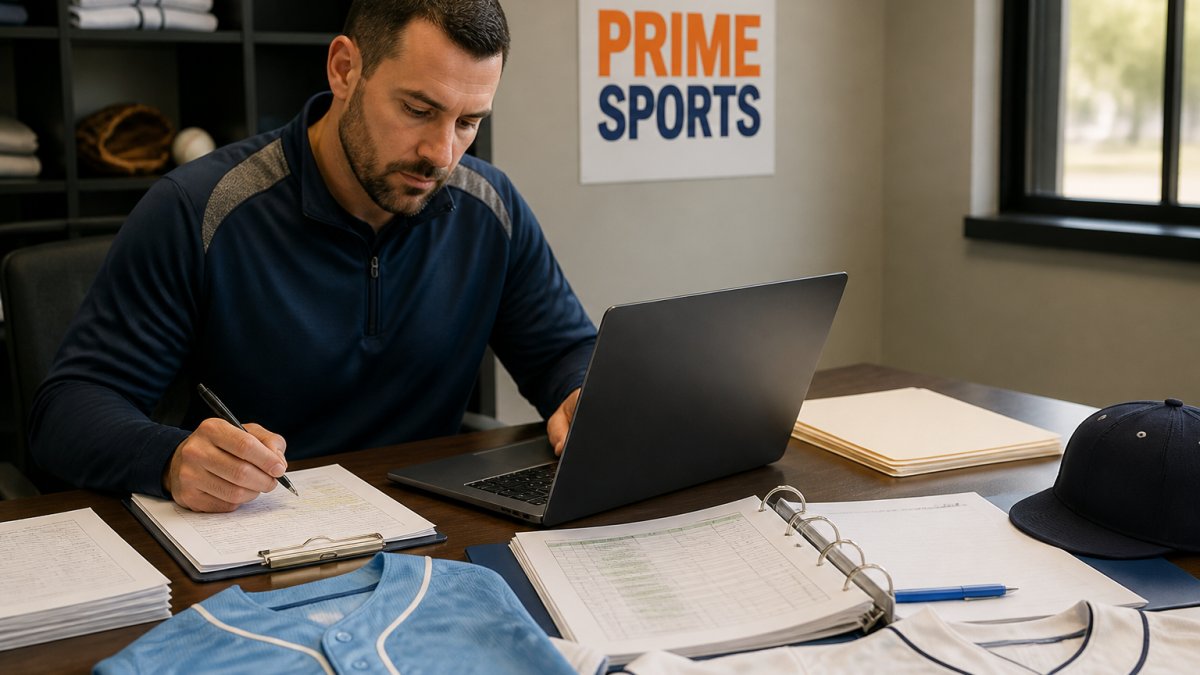
Build the tracking sheet once, reuse it every season
Whether you use Google Sheets, Excel, or a team-management platform, the columns matter more than the tool:
| Column | What goes in it |
|---|---|
| Athlete name | Last, First, sort alphabetically so you can scan fast |
| Parent/guardian + contact | Phone and email in one cell |
| Total owed | The full uniform cost for that athlete |
| Amount paid | Running total, updated each time money arrives |
| Balance remaining | Formula: =Total owed - Amount paid
|
| Payment method | Cash, check number, card, app, or team store |
| Date received | The date the payment cleared, not the date it was promised |
| Status | Paid / Partial / Unpaid / Payment plan |
| Notes | Hardship flag, promised date, follow-up history |
Two formulas do most of the work: Balance remaining calculates automatically, and a Status column driven by an IF statement, for example, =IF(Balance=0,"Paid",IF(Amount paid>0,"Partial","Unpaid")), lets you filter to outstanding rows in one click.
Reconcile weekly, not monthly
Set a recurring 15-minute block every Friday:
- Open your bank or payment-app statement and your tracking sheet side by side.
- Match each deposit to a row; flag unmatched deposits in Notes and follow up before the weekend.
- Update the
Amount paidandDate receivedcolumns. - Filter to
Status = UnpaidorPartialand note who needs a reminder next week.
Weekly reconciliation separates coaches who catch problems early from those who discover a $600 shortfall the week uniforms ship.
Pick the right tool for your team size
- Under ~20 athletes: A shared Google Sheet plus a payment app (Venmo, Cash App, Zelle, or your bank's transfer) is enough. Keep it in a shared drive so an assistant can update it.
- 20-60 athletes: A team-management platform with built-in payment tracking (SportsEngine, TeamSnap, Stack Team App, or a vendor-hosted team store) pays for itself in saved admin hours.
- 60+ athletes or multiple squads: Use a vendor-hosted team store with a dashboard for real-time order status, payment status, and exportable reports. Most custom uniform vendors provide this.
Keep records that survive a season
At season's end, export your sheet to PDF and store it with order confirmations and vendor invoices. Keep records per your organization's retention policy, many youth sports organizations ask for three years. If a parent disputes a charge in month eight, you want the receipt, order form, and payment log in one folder.
Never track payments in a personal Venmo or Cash App account tied to your own bank. Use a dedicated team account or your organization's account so the money is auditable and you are not personally liable if a dispute arises.
What to do when a payment does not match an order
Mismatches happen: a parent pays $150 when the order was $175, or two siblings' payments get combined. When you spot one during weekly reconciliation:
- Do not guess. Send a short message: "Hi [name], I see a payment of $X on [date]. Can you confirm which athlete and which items this covers?"
- Update the Notes column so the next person understands.
- If the payment was short, add the remaining balance to
Balance remainingand include it in the next reminder cycle.
Build the sheet once, reconcile weekly, and you will never wonder who still owes what.
Setting a Team Uniform Payment Deadline
Your team uniform payment deadline needs to be realistic but firm, early enough that uniforms arrive before the season, late enough that families can gather funds.
Most coaches set the deadline 4-6 weeks before uniforms are needed. If your season starts in March, set the deadline in January, giving the vendor time to produce and ship and families time to pay.
Build in a small buffer: if your deadline is January 15, don't place the order until January 20, giving stragglers a few extra days without pushing delivery.
Handling Late or Missed Payments
Late payments are a normal part of running a uniform program. What separates a smooth season from a stressful one is having a written escalation path and message templates ready before the first deadline passes.
The escalation timeline
Day 0, Deadline passes. No action. Give families a 48-hour grace window; life happens.
Day 2, Friendly reminder. Short, warm, no accusation.
Day 7, Direct follow-up. Reference the amount and offer options.
Day 14, Phone call or in-person conversation. A two-minute call usually resolves what text and email can't.
Day 21, Involve your organization. Loop in your athletic director, booster club treasurer, or league administrator.
Message templates you can copy
Keep these in a notes app so you're not writing from scratch at 10 p.m.
Reminder (Day 2):
Hi [name], quick reminder that [athlete]'s uniform payment of $[amount] was due [date].
Follow-up (Day 7):
Hi [name], checking in on the $[amount] balance for [athlete]'s uniform.
Hardship check-in (Day 14):
Hi [name], I wanted to reach out personally about the uniform balance.
Payment plans that actually work
A payment plan is a tool that gets you paid and keeps the athlete in uniform. A simple structure:
- Split the total into 2-4 installments.
- Set fixed dates (for example, the 1st and 15th of each month).
- Put the plan in writing, even if it's just an email confirmation.
A three-installment plan over six weeks covers most families who need flexibility.
Hardship and assistance, handled confidentially
Some families genuinely cannot pay the full amount. Have a quiet process ready:
- Team fundraiser pool. Set aside fundraising proceeds for uniform assistance. Don't announce who receives it.
- Sliding scale. If your organization allows it, offer a reduced rate based on need. Document the approval in your records, not the team chat.
- Sponsor a uniform. Booster clubs and local businesses may cover a specific athlete's uniform. Keep sponsor and recipient anonymous unless both agree otherwise.
Refunds, cancellations, and reconciliation
Uniform orders are custom, so most vendors won't accept returns once production starts. Set that expectation in your policy before orders are placed.
- Before the order is placed: Full refund if a family withdraws.
- After the order is placed but before production: Partial refund, minus any vendor restocking or cancellation fee.
- After production starts: No refund. The family still owes the balance, and the uniform is theirs.
When a refund is issued, log the date, amount, and reason in your tracking sheet, update Balance remaining to zero, and change the status to Refunded. Keep the original payment record, the history protects you if questions arise later.
When to escalate to your organization
Escalate when:
- A family has not responded to three documented follow-ups over 21 days.
- A payment has bounced or been reversed.
- A family disputes the charge.
Bring your tracking sheet, the signed order form, and a written summary of follow-ups. Organizations resolve these cases far faster with documentation than a verbal account.
Handled this way, late payments become routine admin instead of a season-defining conflict, and families remember you treated them fairly.
Conclusion
Managing team uniform payments doesn't have to be chaotic. A clear policy, a simple order form, and consistent follow-up eliminate most problems before they start. At Prime Sports, we help coaches simplify this process with online team stores and custom uniform builders. Our team can walk you through setting up a system that works for your team size and budget.
Frequently Asked Questions
How should a coach collect uniform payments from a team?
Collect payments through a centralized team store or payment portal that parents can access online. This reduces back-and-forth communication and creates a record of who has paid. You can use a team store platform that tracks individual orders and payments, email payment reminders with clear deadlines, or a combination of both. Always provide multiple payment options, check, credit card, or digital payment, to accommodate different family preferences. Make the process transparent by showing families exactly what they're paying for and when payment is due.
When should coaches collect money for team uniforms?
Collect payments as early as possible, ideally 4 to 6 weeks before uniforms are needed. This gives you time to place the order with your uniform vendor, account for production and shipping delays, and follow up with families who miss the deadline. Set a firm payment deadline at least 2 to 3 weeks before the uniforms are required for competition or team events. Communicate the timeline clearly in writing so families know when to expect payment requests and when funds must be received.
What should a team uniform payment policy include?
A clear payment policy should specify the total uniform cost per athlete, what items are included, the payment deadline, accepted payment methods, late payment procedures, and what happens if a family cannot afford the full cost. Include details about refunds or credits if an athlete leaves the team, how you'll handle partial payments, and whether financial assistance is available. Make the policy accessible to all families in writing, email, team website, or printed handout, and require parents to acknowledge they've reviewed it before placing orders.
How can coaches keep uniform costs clear for families?
Break down the total cost by item: uniform top, pants, socks, and any embroidered or printed personalization. Show families the per-unit cost and explain why costs vary (e.g., custom embroidery, rush shipping, bulk discounts). Provide a written cost summary before families commit to ordering. If your team uses a vendor that offers custom options, work with them to provide transparent pricing quotes. Avoid surprise fees by listing all costs upfront, production, decoration, shipping, and any handling charges.