

How to Measure for Baseball Pants: A Step-by-Step Guide
Table of Contents
- Why Accurate Measurements Matter for Baseball Pants
- What You'll Need Before You Start
- How to Measure Waist for Baseball Pants
- How to Measure Inseam for Baseball Pants
- Using a Baseball Pants Size Chart
- Baseball Pants Fit Guide: What to Do When Measurements Fall Between Sizes
- Common Measurement Mistakes to Avoid
- Measuring Pants You Already Own
- Frequently Asked Questions
Last Updated: October 21, 2026
Why Accurate Measurements Matter for Baseball Pants
Getting the right fit starts with knowing how to measure for baseball pants accurately. A poorly fitting pair can affect your performance, comfort, and confidence on the field.
The key is understanding two critical measurements: waist and inseam. These two numbers determine whether you'll feel locked in and ready to play or constantly adjusting your uniform.
Most players and parents guess at sizing instead of measuring properly. This leads to returns, wasted money, and missed opportunities to get game-ready. Taking five minutes to measure correctly saves frustration later.
Accurate measurements also matter when shopping across different brands. A youth size small from one manufacturer might fit differently than another brand's small.
What You'll Need Before You Start
To properly measure for baseball pants, you need just a few simple tools. You probably have most of these at home already.
Essential items:
- A soft measuring tape (cloth, not rigid metal)
- A mirror or another person to help
- Comfortable clothing you normally wear
- A pair of pants that fit well (for reference)
- Paper and pen to write down measurements
A soft measuring tape is important because it won't leave marks and gives accurate readings. If you don't have one, most retailers sell them for a few dollars.
Having another person help makes measuring easier and more accurate. They can hold the tape in place while you stay still. For children, a second person is almost essential to get reliable numbers.
How to Measure Waist for Baseball Pants
The waist measurement is the most important number when choosing baseball pants. This measurement determines comfort and fit at the most critical point. Get this wrong, and nothing else matters.
Finding Your Natural Waistline
Your natural waistline is where your body naturally bends when you lean to the side. It's not where your jeans sit or where you wear a belt for everyday clothes. For baseball pants, you need the true waist measurement.
To find your natural waistline:
- Stand in front of a mirror
- Bend slightly to one side
- Feel where your body naturally creases
- That crease is your natural waistline
This spot is typically higher than where casual pants sit. It's usually at or just above your hip bones. For children, have them stand naturally and locate this point on their body.
Taking the Measurement
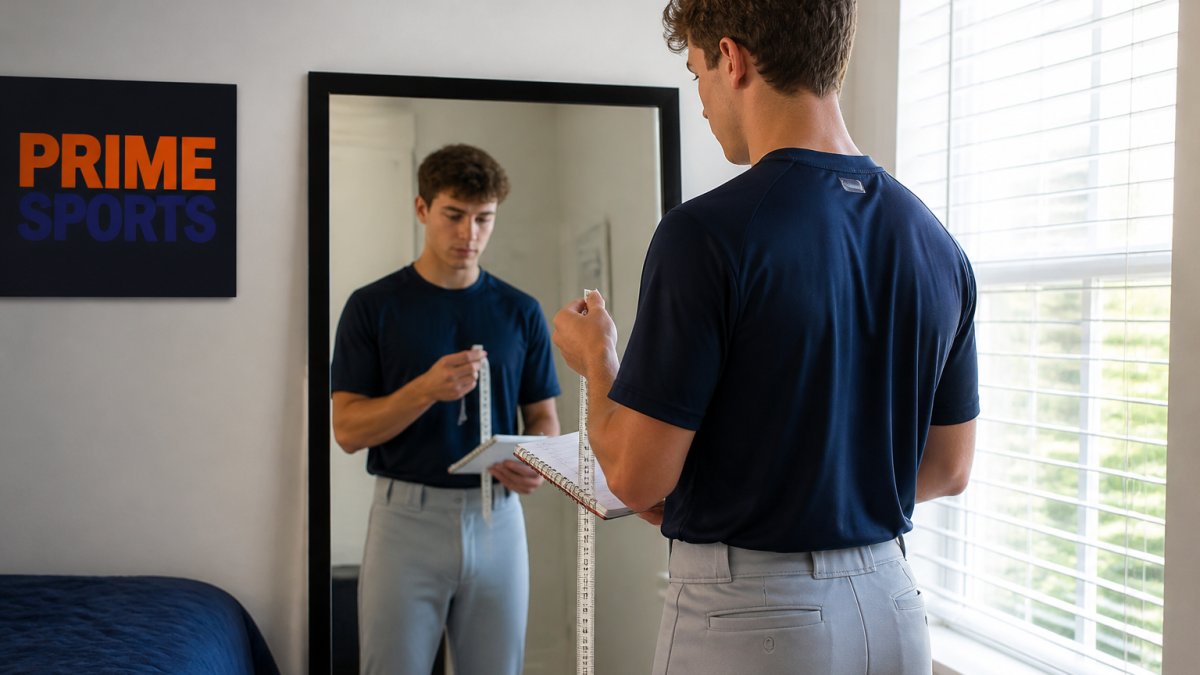
Position the measuring tape around your waist at your natural waistline. Keep the tape snug but not tight.
Steps for accurate waist measurement:
- Wrap the tape around your waist horizontally
- Keep the tape level all the way around
- Make sure it's not twisted or bunched
- The tape should be snug but allow one finger to fit underneath
- Read the measurement where the tape overlaps
- Write down the number in inches
Don't pull the tape too tight. A common mistake is cinching the tape as if you're measuring for a belt. This gives a smaller number than your actual waist size.
For children, have them stand still while you wrap the tape. Keep them relaxed, don't have them hold their breath or suck in their stomach.
How to Measure Inseam for Baseball Pants
The inseam measurement determines the length of your baseball pants. This is the distance from your inner thigh down to your ankle. Getting this right ensures your pants land at the correct spot on your leg.
Measuring Standing Up
The most accurate way to measure inseam is while standing. You want your pants to sit at a specific length on your leg, typically at or just above your ankle for open-bottom pants, or above the knee for knickers.

Steps for measuring inseam:
- Stand barefoot on a flat surface
- Have someone measure from your inner thigh to your ankle
- The tape should start at the top of your inner thigh, near the groin
- Run the tape straight down the inside of your leg
- End the measurement at your ankle bone
- Write down the measurement in inches
Stand naturally with your feet about shoulder-width apart. Don't stretch or lean. Your helper should keep the tape straight and vertical along your leg.
For open-bottom baseball pants, the inseam typically lands at your ankle or slightly above it. Prime Sports carries both styles, including the Midstopper Above the Knee Youth Knicker Baseball Pant, which is designed to fit shorter and tighter for that classic look.
Measuring a Child with Help
Measuring a child's inseam requires a second person. Children often move or fidget, which throws off measurements. Having one adult measure while another keeps the child still produces the most accurate results.
Tips for measuring children:
- Have the child stand on a step or low stool if needed (so you don't have to bend as far)
- Keep the child relaxed and still
- One person holds the tape, the other keeps the child steady
- Measure from the inner thigh straight down to the ankle
- For very young children, measure twice to confirm
If your child is between sizes, measure twice on different days. Consistency across measurements gives you confidence in the number. If the measurements differ by more than half an inch, measure a third time.
Using a Baseball Pants Size Chart
Once you have your waist and inseam measurements, you need to match them to a size chart. Different brands use slightly different sizing, so always check the specific chart for the pants you're buying.
Youth Sizing
Youth baseball pants typically come in sizes XS, S, M, L, and XL. Waist sizes for youth range from about 24 inches to 32 inches. Inseams for youth usually range from 24 inches to 32 inches.
Youth sizing depends on both height and weight. A child who is tall but thin might wear a different size than a child who is shorter but heavier. This is why both measurements matter.
Midstopper Above the Knee Youth Knicker Baseball Pant →
Typical youth size ranges:
- Extra Small: waist 24-26 inches, inseam 24-26 inches
- Small: waist 26-28 inches, inseam 26-28 inches
- Medium: waist 28-30 inches, inseam 28-30 inches
- Large: waist 30-32 inches, inseam 30-32 inches
- Extra Large: waist 32-34 inches, inseam 30-32 inches
These are general guidelines. Always check the specific size chart for the pants you're buying. The Champro Triple Crown 2.0 Youth Open Bottom Baseball Pant includes a detailed chart to help you find the right fit.

Adult Sizing
Adult baseball pants come in sizes S, M, L, XL, and XXL. Waist sizes typically range from 28 inches to 40 inches. Inseams usually range from 30 inches to 34 inches.
Adult sizing is more straightforward than youth sizing because height and weight variations are more predictable. However, fit preferences still matter. Some players prefer a tighter fit, while others want more room for movement.
Typical adult size ranges:
- Small: waist 28-30 inches, inseam 30-31 inches
- Medium: waist 30-32 inches, inseam 31-32 inches
- Large: waist 32-34 inches, inseam 32-33 inches
- Extra Large: waist 34-36 inches, inseam 33-34 inches
- XXL: waist 36-40 inches, inseam 34 inches
The Midstopper Above the Knee Adult Knicker Baseball Pant and Alleson 605WLP Adult Open Bottom Baseball Pant both provide size charts specific to their fit and style.

Baseball Pants Fit Guide: What to Do When Measurements Fall Between Sizes
Sometimes your measurements don't line up perfectly with a single size. Your waist might be a small, but your inseam fits a medium. This is common and fixable.
When measurements fall between sizes, prioritize the waist. The waist is harder to alter, and a poor waist fit affects comfort more than length. You can always hem pants that are too long, but you can't easily make the waist bigger if it's too small.
Decision guide for between-size measurements:
| Situation | Best Choice |
|---|---|
| Waist is between sizes | Size up for comfort |
| Inseam is between sizes | Size down to avoid excess length |
| Both measurements are between sizes | Go up in waist, down in inseam |
| Unsure which way to go | Size up, too tight is worse than too long |
If you're buying knicker-style pants, sizing up is especially important. The Midstopper Above the Knee Youth Knicker Baseball Pant runs small and fits tighter at the thigh by design. Prime Sports recommends sizing up if you're between sizes for this style.
Common Measurement Mistakes to Avoid
Even experienced players make measurement errors. Knowing what to avoid saves time and prevents wrong-sized purchases.
Mistake 1: Measuring over clothing. Always measure directly on your skin or very thin clothing.
Mistake 2: Pulling the tape too tight. A tight tape gives a smaller measurement than your actual size.
Mistake 4: Measuring while holding your breath. Have the person being measured breathe normally.
Mistake 5: Measuring inseam while sitting. Inseam must be measured standing up. Sitting compresses your leg and gives a shorter measurement.
Mistake 6: Ignoring brand-specific sizing. Different manufacturers use different sizing standards.
Mistake 7: Guessing instead of measuring. Many people skip measuring and just buy what they wore last year.
Measuring Pants You Already Own
If you already own baseball pants that fit well, you can measure them to use as a reference.
Lay the pants flat on a table. Measure across the waist from seam to seam, then double that number. For inseam, measure from the crotch seam down to the hem.
This method is less accurate than measuring your body directly, but it works when you know a specific pair fits correctly. Use it as a backup check if your body measurements seem off.
When ordering replacement pants or a different style, measure your body first, then compare to the size chart. Use the existing pants as a secondary reference only.
Frequently Asked Questions
How do you measure your waist for baseball pants?
Locate the top of your hip bone and measure horizontally around your body at that point. Keep the measuring tape snug but not tight, you should be able to fit one finger underneath. This measurement is critical for baseball pants because the waist determines comfort and fit. Write down the number and compare it to the size chart for your specific brand, as waist sizing varies slightly between manufacturers.
How do you measure inseam for baseball pants?
Stand barefoot with your feet shoulder-width apart and measure from the inside of your thigh (where your leg bends) down to your ankle. For youth players, have a parent or coach help hold the measuring tape in place. The inseam measurement determines pant length and affects the overall look and function of the uniform. Check the size chart after measuring to find the correct length for your height and build.
What should I do if my measurements fall between two sizes on a baseball pants size chart?
Size up if you're between sizes, especially in youth baseball pants. Many styles, like the Midstopper Above the Knee Youth Baseball Knicker, are designed to fit tighter in the thigh and may run small. Sizing up gives you room to move on the field and ensures the pants won't feel restrictive. Check the specific size chart for the brand you're buying, some manufacturers provide guidance on whether to size up or down.
Should baseball pants fit tight or loose?
Baseball pants should fit snugly at the waist and thigh to allow unrestricted movement and prevent the pants from sliding down during play. The waistband should sit at your hip bone, and the thigh should feel fitted but not constrictive. Length depends on your style preference, knickers land above the knee, while open-bottom pants extend to your ankle. The fit should allow you to run, slide, and bend without discomfort.
Getting the right size for baseball pants comes down to two accurate measurements: waist and inseam. Take time to measure correctly, and you'll find pants that fit your body and let you focus on playing. Prime Sports carries a full selection of youth and adult baseball pants from top brands, and our team can help you find the right size and style for your needs. Shop our baseball pants collection at PrimeSportsMW.com or visit us in-store to get expert guidance on fit and sizing.