
How to Design Custom Team Logos: A Step-by-Step Guide
Table of Contents
- Gather Team Input and Define Your Brand Identity
- Generate Team Logo Design Ideas and Brainstorm Concepts
- Sketch Initial Concepts and Choose a Logo Style
- Select Symbols, Mascots, and Imagery for Your Design
- Choose Your Color Palette and Typography
- Explore Sports Logo Templates and Customization Options
- Prepare Logo File Formats for Printing and Create Team Branding Guidelines
- Test Your Logo for Small-Size Legibility and Accessibility
- Frequently Asked Questions
Last Updated: October 18, 2026
Gather Team Input and Define Your Brand Identity
Custom team logos fail most often at discovery, not drawing. Before anyone opens a sketchbook, run a short, structured process that turns input from players, coaches, parents, and fans into a written design brief.

Who to talk to (and what to ask each group)
You don't need a formal committee, but you need more than one perspective. Interview four groups separately:
- Players and captains: Ask what they want to feel when they put on the uniform. What words should opponents think of when they see the logo? What do they not want to look like?
- Coaches and program leadership: Ask about tradition, league rules, uniform vendors, and any existing marks the program already owns or licenses.
- Parents and boosters: Ask what merchandise they would actually buy and wear. They order the hats, hoodies, and car decals, so their input on readability and price matters.
Keep each conversation to 15-20 minutes, ask the same core questions, and record responses in a shared document.
Turn input into a one-page design brief
A design brief isn't a mood board or wish list. It's a one-page document telling a designer what the logo must do:
- Team name and any required text, including whether the full name, abbreviation, or both must appear.
- Three to five brand attributes in plain language (for example: disciplined, fast, community-rooted, modern). Avoid vague words like "cool" or "professional" without a concrete example.
- Required colors and any colors to avoid, with a note on whether existing uniforms or league rules constrain the palette.
Resolve conflicts before design starts
Discovery almost always surfaces disagreement: players want aggressive, parents want readable on a hat, leadership wants consistency with the school or league. Don't let the designer arbitrate. Rank the brief's priorities explicitly (for example, "small-size legibility outranks visual complexity") and get sign-off before sketches begin.
A signed-off brief shortens revision cycles and gives you a defensible answer when someone asks why the logo omits their favorite idea.
Generate Team Logo Design Ideas and Brainstorm Concepts
Brainstorming works best when you cast a wide net. Gather your design team and spend 30 minutes generating ideas without judgment. Write down everything.
Look for inspiration in unexpected places:
- Other sports logos in your league or region
- Historical logos from your school or organization
- Nature, animals, or local landmarks tied to your area
Search for "team logo design ideas" and "sports logo templates" online to see what resonates. Don't copy, use them as starting points.
Create a mood board of 10-15 logo examples close to your vision, pinned to a wall or in a digital folder, to keep your team aligned.
Sketch Initial Concepts and Choose a Logo Style
Now grab a pencil. Sketching is where ideas become real. Don't worry about perfection, rough sketches are faster and often better than polished digital versions at this stage.
Sketch 5-10 rough concepts. Try different approaches:
- Emblem style (circular badge with text around the edge)
- Mascot-focused (animal or character as the main element)
- Wordmark (stylized team name)
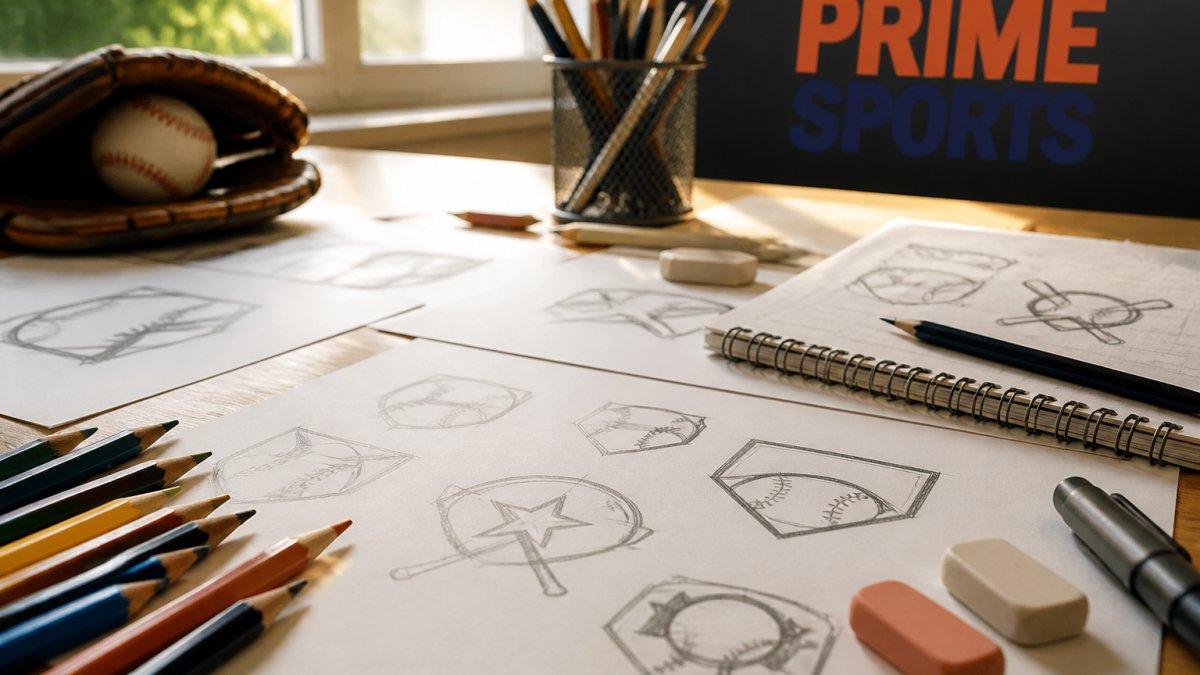
Vote on your top 3-5 sketches and ask team members which feel right. Gut reactions matter. Narrow down to 2-3 concepts that best capture your team's identity.
Choose a primary logo style. This decision affects everything else:
- Emblem/Badge: Traditional, formal, works well on uniforms
- Mascot: Playful, memorable, easier to animate for social media
- Wordmark: Clean, modern, works at any size
Select Symbols, Mascots, and Imagery for Your Design
Symbols and mascots carry the most legal and originality risk. A design that resembles an existing mark can force a rebrand after uniforms and merchandise are printed. Build a short clearance process into symbol selection.
Choose imagery that fits the team and the medium
Start with categories that match the team's identity and the places the logo will appear:
- Animals and mascots: Pick a creature whose silhouette reads at small sizes. A detailed dragon may look impressive on a poster but becomes a blur on a cap or helmet decal.
- Local landmarks and geography: Mountains, rivers, bridges, and skyline shapes can tie a team to its community, but simplify them into bold shapes rather than illustrations.
- Heritage symbols: Shields, crests, and letterforms from a school or program's history can signal tradition, provided the program actually owns or has permission to use them.
Whatever you choose, test the idea as a one-color silhouette. If the symbol is not recognizable in solid black at roughly the size of a thumbnail, simplify it before moving to color.
Run an originality and trademark check before you fall in love with a concept
This is the step most team-logo guides skip. You don't need a lawyer for a first-pass screen, but you do need to be systematic:
- Search the USPTO trademark database for the team name, mascot name, and any slogan you plan to use. Look for live marks in the same class of goods (apparel, sporting goods, entertainment services) and note confusingly similar spellings and designs, not just exact matches.
- Search your league, conference, and state association for registered or protected marks. Many youth, school, and amateur leagues maintain their own logo registries or approval processes.
- Reverse-image search each candidate symbol and mascot concept to catch designs that are close to an existing professional, college, or well-known amateur mark.
- Check the mascot itself, not just the drawing. If the team name or mascot name is already in use by another program in your area, a different drawing may still create confusion.
- Document what you find. Keep a simple log of searches, dates, and results so you can show due diligence if a question arises later.
If a search turns up a conflicting mark, change the concept early. Redesigning a sketch is cheap; redesigning uniforms and merchandise after a complaint is not.
Avoid copied marks and unauthorized imagery
Two failure modes are common:
- Tracing or closely adapting an existing logo. Changing colors or flipping a mark does not make it original. Avoid building a concept by tracing a professional or college logo, even as a placeholder.
- Using protected imagery without permission. College and professional team marks, league logos, and many mascot characters are protected. Do not incorporate them into a team logo unless you have written permission or a license that covers your use.
Confirm ownership and usage rights in writing
If you hire a designer, the contract should state who owns the final artwork and what rights transfer. Ask about:
- Ownership of the final vector source files, not just exported images.
- Whether the team can modify the logo later without additional fees.
- Whether the designer retains the right to display the work in a portfolio.
A short written agreement prevents disputes when the team later orders merchandise or changes vendors. Once symbol, mascot, and ownership terms are settled, move into sketching with confidence.
Choose Your Color Palette and Typography
Colors carry meaning and affect how your logo looks on uniforms, hats, merchandise, and social media.
Pick 2-3 primary colors maximum. Too many colors make logos confusing and expensive to reproduce. Consider:
- High contrast: Dark and light colors work together (navy and white, black and gold)
- Team tradition: Use colors already associated with your program
- Visibility: Colors need to stand out on uniforms and in photos
Test your colors on white and dark uniforms and on social media. Colors that pop on screen sometimes disappear when printed.
Custom Toughman Champion Ring- Tim Ray →
Typography matters as much as the symbol. Choose 1-2 fonts for your team name or text elements:
- Bold, strong fonts: Convey power and confidence
- Serif fonts: Traditional, classic look
- Sans-serif fonts: Modern, clean appearance
Avoid trendy fonts, your logo should work for 5-10 years, and trendy fonts look dated in 18 months. Pick timeless typefaces that fit your team's personality.
Explore Sports Logo Templates and Customization Options
You have two paths: hire a designer or customize a template yourself.
Template approach: Many online platforms offer sports logo templates.
Custom design approach: Work with a designer (freelance or agency) to create something unique.
If you choose templates, look for options that let you:
- Change colors easily
- Edit text and fonts
- Adjust the mascot or symbol
When working with a designer, provide your brief and mood board. Clear communication prevents back-and-forth revisions.
Prime Sports can guide you through the customization process for team apparel.
Prepare Logo File Formats for Printing and Create Team Branding Guidelines
Your logo needs multiple formats for different uses, critical for long-term consistency.
Essential file formats:
- Vector files (AI, EPS, PDF): Scalable to any size without losing quality, required for printing
- High-resolution raster (300 DPI PNG or TIFF): For digital use and large prints
- Web-ready (72 DPI JPG or PNG): For social media and websites
Ask your designer to provide all these formats. If you're using templates, download every available format offered.
Test at small sizes: print it 1 inch wide. Can you read the text and see the details? If not, simplify the design or enlarge the smallest elements.
Establish Team Branding Guidelines for Consistency
Create a simple one-page branding guide that documents your logo standards:
- Logo placement: Where text goes relative to the symbol
- Minimum size: Never print smaller than this dimension
- Color specifications: Exact hex codes and Pantone numbers
This guide keeps everyone on the same page when a parent orders a hat or a vendor creates a poster. Consistency builds brand recognition.
Share your branding guide with anyone who handles your team's visual identity, coaches, parents ordering merchandise, vendors creating uniforms. One consistent logo is stronger than five variations.
Test Your Logo for Small-Size Legibility and Accessibility
Small-size legibility matters. Your logo appears on baseball caps, chest embroidery, and social media thumbnails.
Test accessibility too. Does your logo work in black and white?
Get feedback from people outside your team.
Once you're satisfied, lock in your logo. Resist the urge to tweak it constantly.
Designing custom team logos is a process, not a quick task.
At Prime Sports, we help teams bring their logos to life on uniforms, hats, and apparel.
Frequently Asked Questions
What file format should a custom team logo be in for printing on uniforms?
Vector formats like EPS, AI, or PDF are ideal for printing because they scale without losing quality. For embroidery and screen printing, suppliers typically need vector files. For digital use (social media, websites), export as PNG or SVG. Always confirm your printer's requirements before finalizing your custom team logo files, different decoration methods (screen printing, sublimation, embroidery) may need different formats or color specifications.
How do I avoid copyright and trademark issues when designing a team logo?
Search the U.S. Patent and Trademark Office (USPTO) database and Google Images to verify your design concept is original. Avoid copying existing team logos, professional sports marks, or recognizable symbols. If using a mascot or animal, ensure it's a generic representation, not a trademarked character. Document your design process to prove originality. When in doubt, consult a trademark attorney before printing your logo on merchandise or uniforms.
What makes a team logo work well on jerseys, hats, and other merchandise?
Design with scalability in mind, your logo must remain clear and recognizable when shrunk to 1 inch or enlarged to 12 inches. Use bold shapes and limit fine details that disappear at small sizes. Choose a high-contrast color scheme for visibility on different fabric colors. Test how your design looks in monochrome (black and white) for embroidery. Avoid thin lines under 0.5 points, which break apart during screen printing or embroidery.
Can I use sports logo templates to create my team's custom logo?
Yes, sports logo templates can be a cost-effective starting point, especially for budget-conscious teams. Templates provide structure and professional design foundations. However, customize them significantly to reflect your team's identity, change colors, swap mascots, adjust typography, and add unique elements. Avoid using templates unchanged, as other teams may have identical logos. For maximum originality and brand impact, consider working with a designer or using design software to heavily modify any template you start with.